

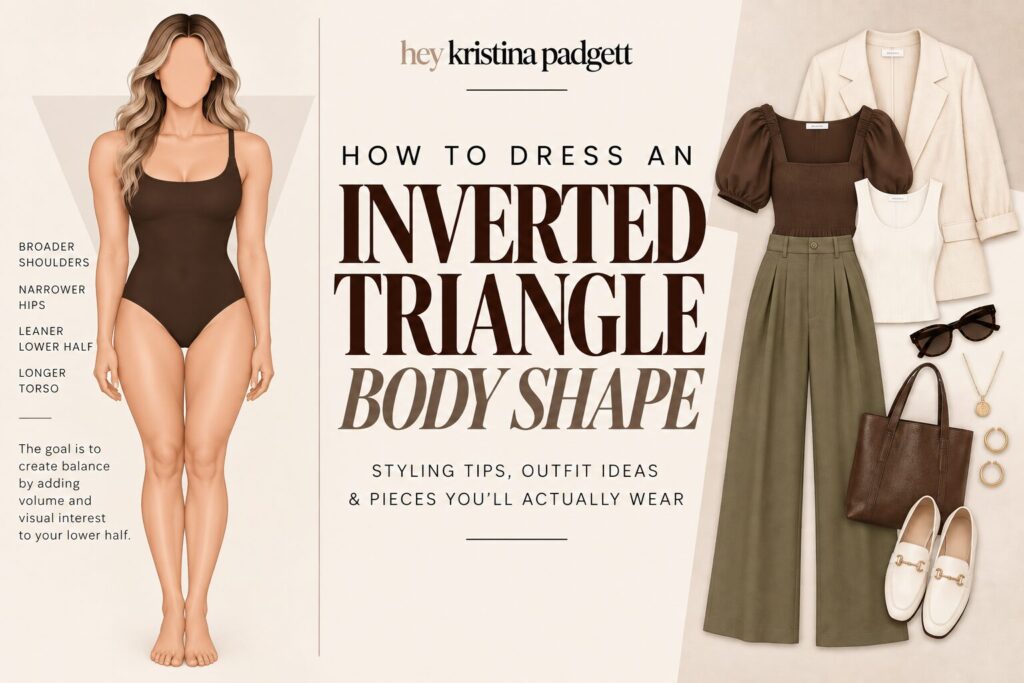
If you have an inverted triangle body shape, you’ve probably heard styling advice that sounds something like:
Make your shoulders look smaller.
Avoid anything that draws attention to your upper body.
Add curves to your hips.
Never wear shoulder details.
I don’t love that approach.
Getting dressed for an inverted triangle body shape isn’t about trying to make your shoulders disappear or forcing your body to look like a different shape.
It’s about understanding your proportions—and then using things like volume, garment length, neckline, rise, structure and silhouette to create the look you want.
Once you understand that, getting dressed becomes a lot less about what you’re “allowed” to wear.
What Is an Inverted Triangle Body Shape?
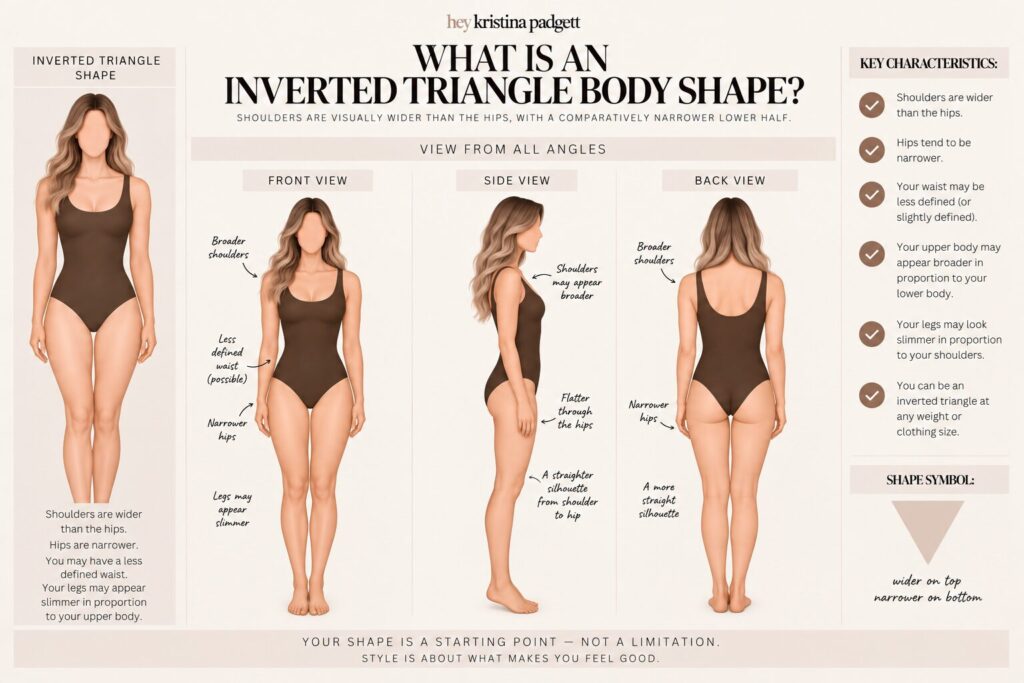
An inverted triangle body shape typically has shoulders that are visually wider than the hips, with comparatively less width through the lower half.
You may have an inverted triangle body shape if:
- Your shoulders are wider than your hips.
- Your upper body may appear broader in proportion to your lower body.
- Your hips may appear relatively narrow.
- Your legs may look slimmer in proportion to your shoulders or torso.
- Your waist may have some definition—or very little.
And something I want to make VERY clear:
Having broad shoulders does not automatically make you an inverted triangle.
Body shape is about the relationship between your shoulders, waist and hips, not one individual feature.
You can also be an inverted triangle at any weight or clothing size.
If you’re still unsure of your body shape, start with my How to Determine Your Body Shape guide before continuing.
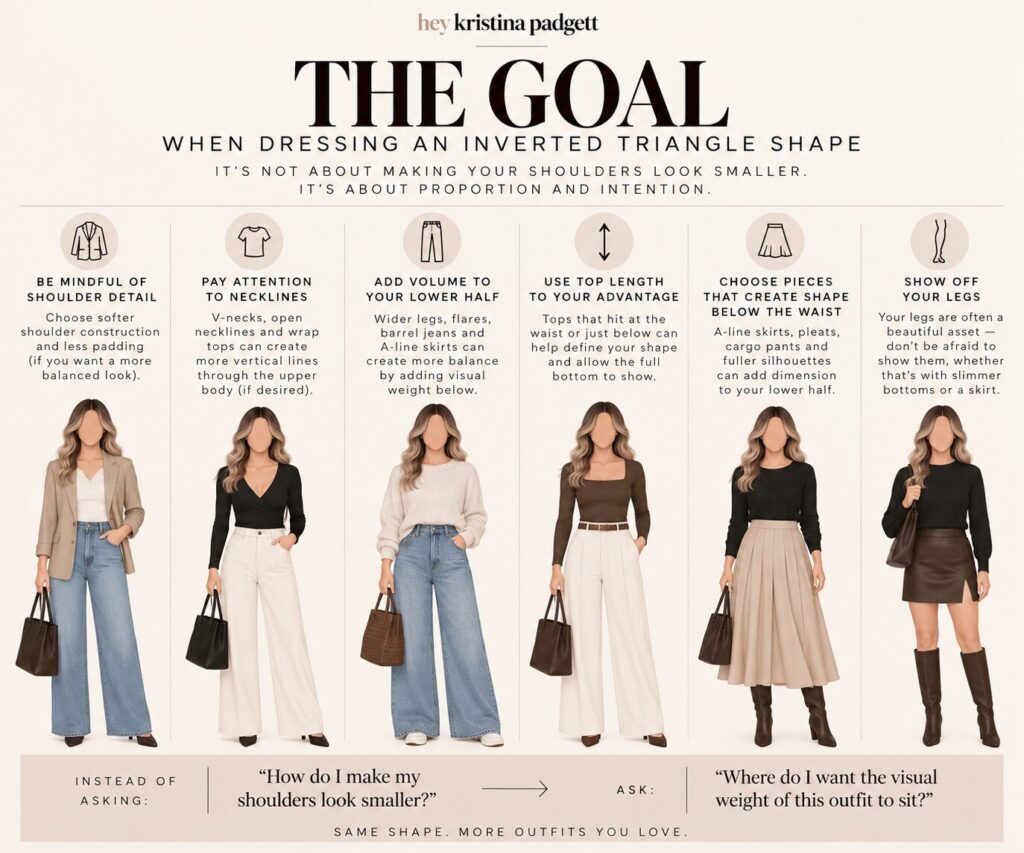
The Goal When Dressing an Inverted Triangle Shape
Traditional inverted-triangle advice tends to focus heavily on:
Minimizing your shoulders.
That’s not my goal.
Your shoulders aren’t a problem we need to solve.
Instead, I want you thinking about visual weight and intention.
With an inverted triangle shape, we’re often playing with:
Where volume sits
How much structure is happening up top
The shape of your pants
Where tops and jackets end
Necklines and shoulder lines
Creating movement through the lower half
You can emphasize your shoulders.
You can create more volume below.
You can do both.
The question isn’t:
“How do I make my shoulders look smaller?”
It’s:
“Where do I want the visual weight of this outfit to sit?”
Once you start asking that question, you have a lot more options.
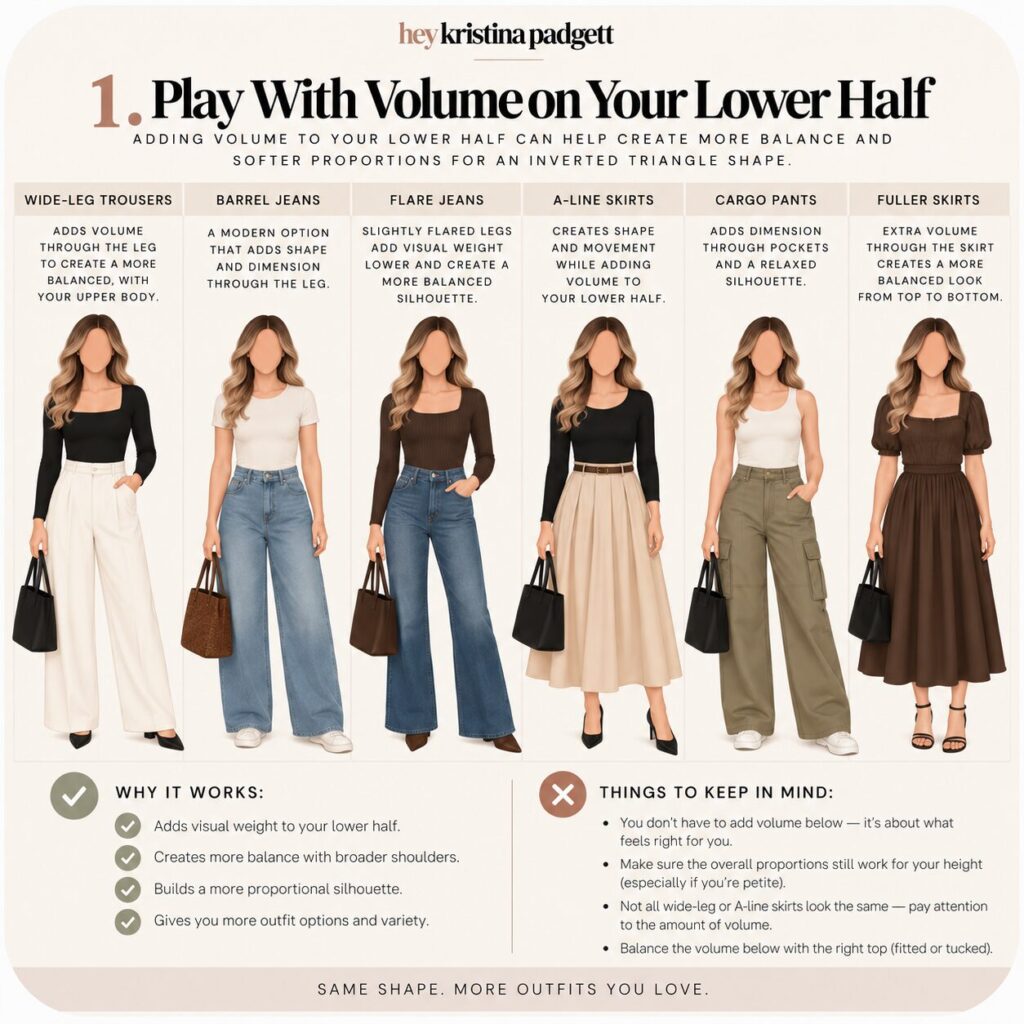
1. Use Volume on Your Lower Half—If You Want It
This is one of the easiest ways to dramatically change the silhouette of an outfit.
Because an inverted triangle naturally carries more visual width through the shoulders than the hips, adding volume through the lower half can create a different sense of proportion.
Try:
Wide-leg trousers
Barrel jeans
Wide-leg denim
A-line skirts
Full midi skirts
Pleated trousers
Cargo pants
But here’s the important part:
You don’t have to add volume below.
If you love your broader shoulder line with slim straight jeans, wear it.
We’re not trying to correct your proportions.
We’re learning how to manipulate them.
Try this:
Wear the same fitted top with three bottoms:
Slim straight → wide straight → full wide leg
Take a picture of each.
Notice how the relationship between your shoulders and lower body changes.
That’s information you can actually use when you’re shopping.
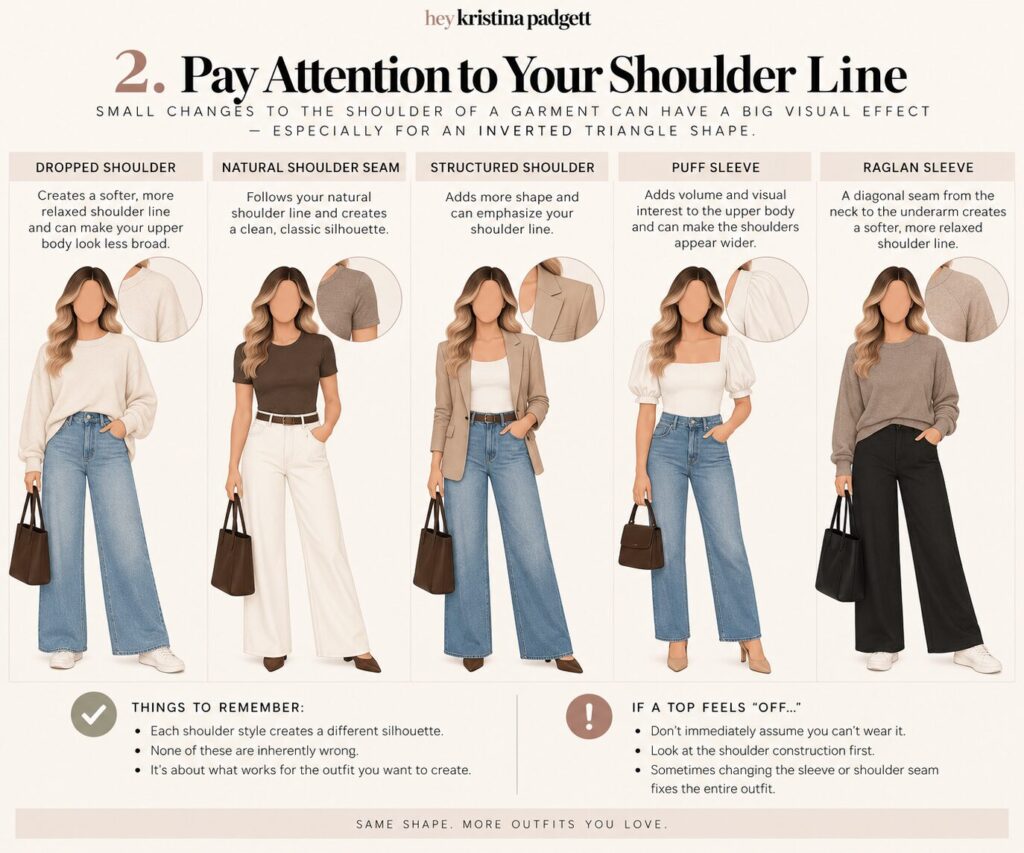
2. Pay Attention to Your Shoulder Line
This one is especially interesting for inverted triangles because tiny changes to the shoulder of a garment can have a surprisingly big visual effect.
Compare:
Dropped shoulder
Natural shoulder seam
Structured shoulder
Puff sleeve
Raglan sleeve
They don’t create the same silhouette.
A structured blazer may emphasize your shoulder line.
A softer shoulder construction may make that line less prominent.
A puff sleeve can add even more visual interest up top.
None of those are inherently wrong.
The question is whether that effect works with the outfit you’re trying to create.
If a top feels “off,” don’t immediately decide:
“I can’t wear this because I have broad shoulders.”
Look at the actual shoulder construction first.
Sometimes changing the sleeve or shoulder seam fixes the entire outfit.
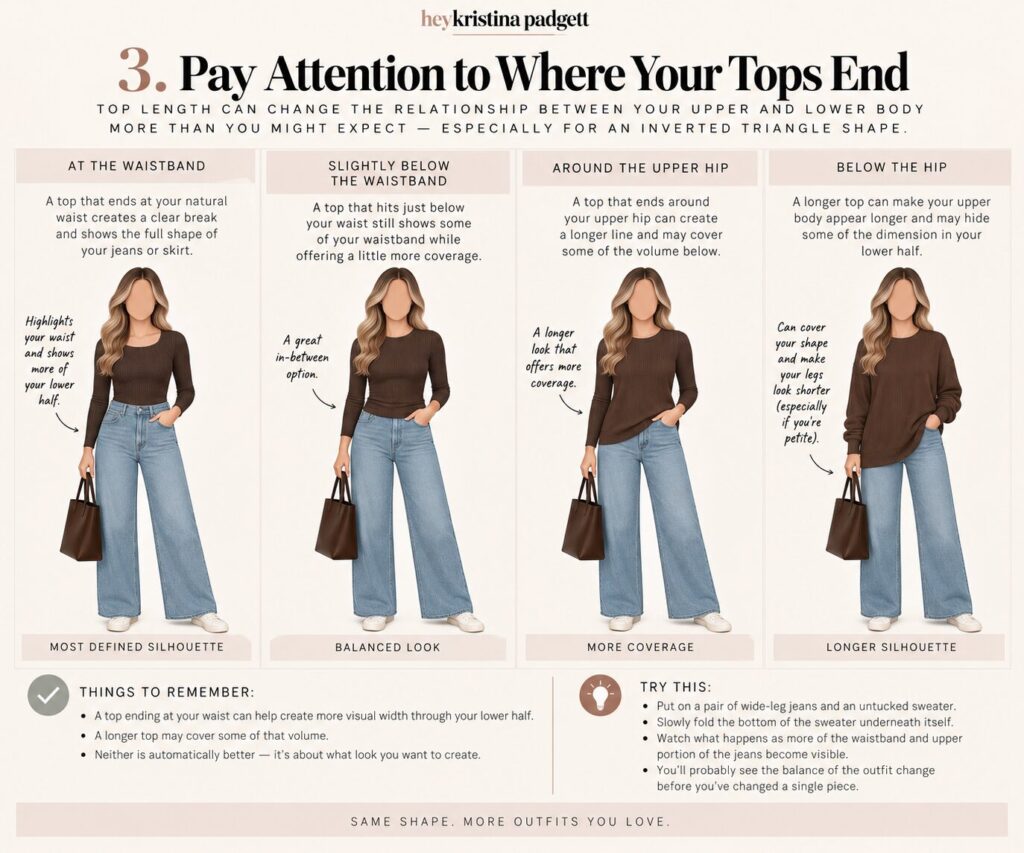
3. Pay Attention to Where Your Tops End
Top length can change the relationship between your upper and lower body more than you might expect.
A top ending right around your waistband creates a very different proportion from one that extends several inches over your hips.
Try experimenting with tops that end:
- At the waistband
- Slightly below the waistband
- Around the upper hip
- Below the hip
If you want to create more visual width through your lower half, a top ending around your waist can allow the entire shape of your pants or skirt to show.
A longer top may cover some of that volume.
Neither is automatically better.
Try this:
Put on a pair of wide-leg jeans and an untucked sweater.
Slowly fold the bottom of the sweater underneath itself.
Watch what happens as more of the waistband and upper portion of the jeans become visible.
You’ll probably see the balance of the outfit change before you’ve changed a single piece.
4. Your Jeans Matter A LOT
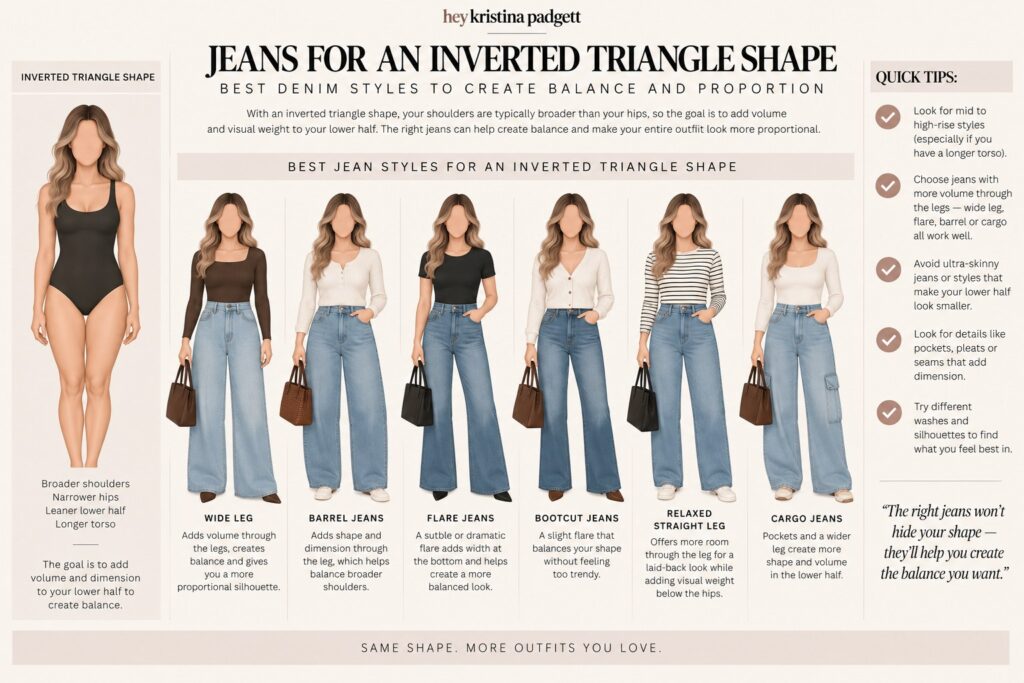
This is one of my favorite areas to experiment with on an inverted triangle shape.
Because your lower half is comparatively narrower, denim gives you an enormous opportunity to change the overall silhouette.
I often love:
Wide-leg jeans
Wide-straight jeans
Barrel jeans
Bootcut jeans
Flare jeans
Relaxed straight jeans
for inverted triangle shapes.
Adding volume through the leg can create more visual weight below.
But that does NOT mean you can’t wear skinny jeans.
Compare:
Skinny jean + fitted top
with:
Wide-leg jean + fitted top
and then:
Skinny jean + oversized blazer
Those are three completely different silhouettes on the exact same body.
Rather than asking:
“Can inverted triangles wear skinny jeans?”
Ask:
“What are these jeans doing to the proportions of my entire outfit?”
That’s a much more useful question.
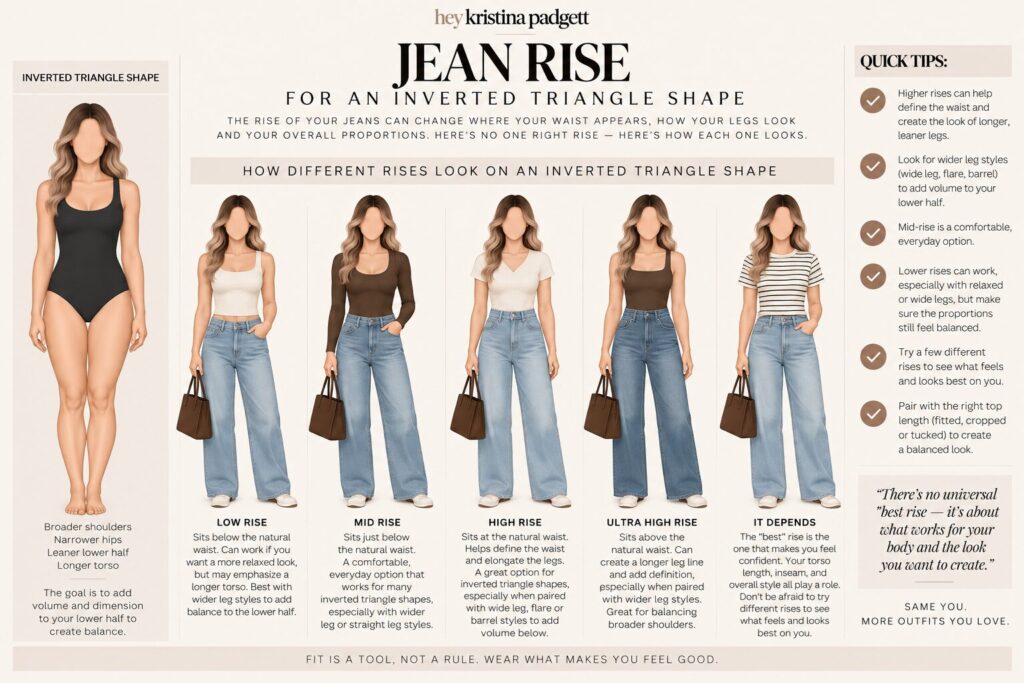
5. Don’t Assume High-Rise Is Always Best
This is going to sound familiar if you’ve read my other body-shape guides.
Your body shape does not determine your ideal rise by itself.
Your ideal rise depends on:
Your torso length + where your natural waist sits + where you carry volume + your height.
A super-high rise might feel incredible on one inverted triangle and completely overwhelm another.
A mid-rise may give you exactly the proportions you want.
Even a lower rise can work beautifully depending on your torso and the silhouette you’re creating.
Don’t shop based solely on:
LOW / MID / HIGH RISE
Look at where the waistband actually lands on your body.
If you’re petite or have a short torso, this becomes even more important.
[LINK: HOW TO TELL IF YOU HAVE A SHORT OR LONG TORSO]
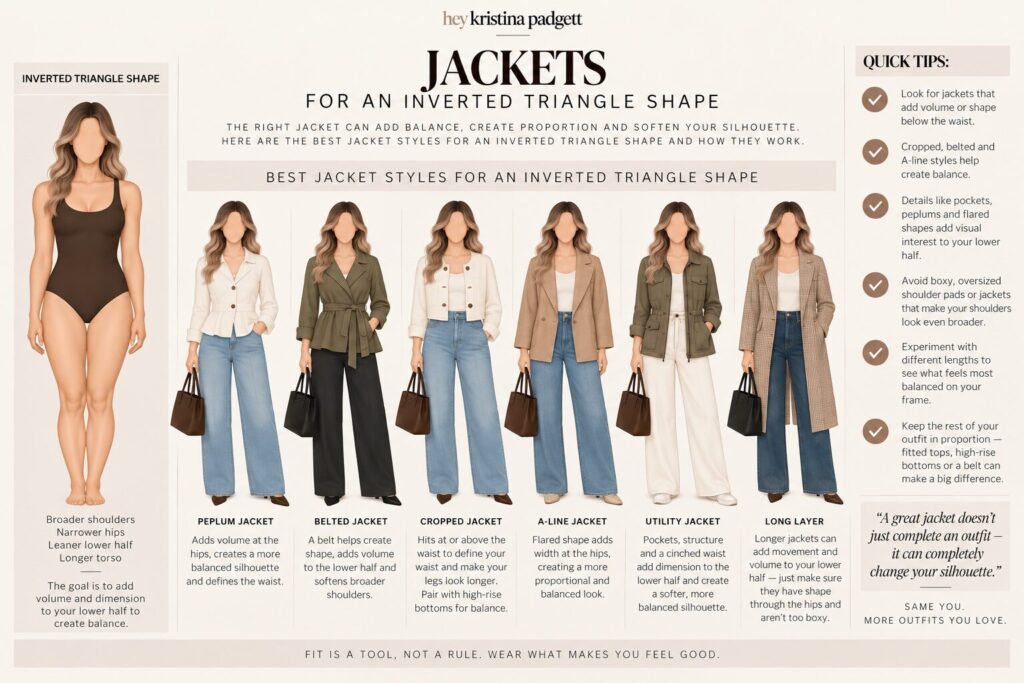
6. Use Jackets Intentionally
Jackets are especially powerful on an inverted triangle because they can change both your shoulder line and your overall silhouette at the same time.
Try:
Cropped jackets
Waist-length jackets
Soft blazers
Open blazers
Denim jackets
Longer structured layers
A heavily structured blazer with strong shoulders can emphasize your upper body.
If that’s the look you want? Great.
If it feels like too much visual weight up top, try a blazer with:
Softer shoulders
Less padding
A more fluid fabric
A slightly narrower lapel
And always pay attention to where the jacket ends.
A shorter jacket paired with wide-leg trousers can create a dramatically different proportion from a long blazer paired with skinny jeans.
You may not dislike blazers.
You might dislike that blazer with those pants.
7. Use Necklines to Change the Upper-Body Silhouette
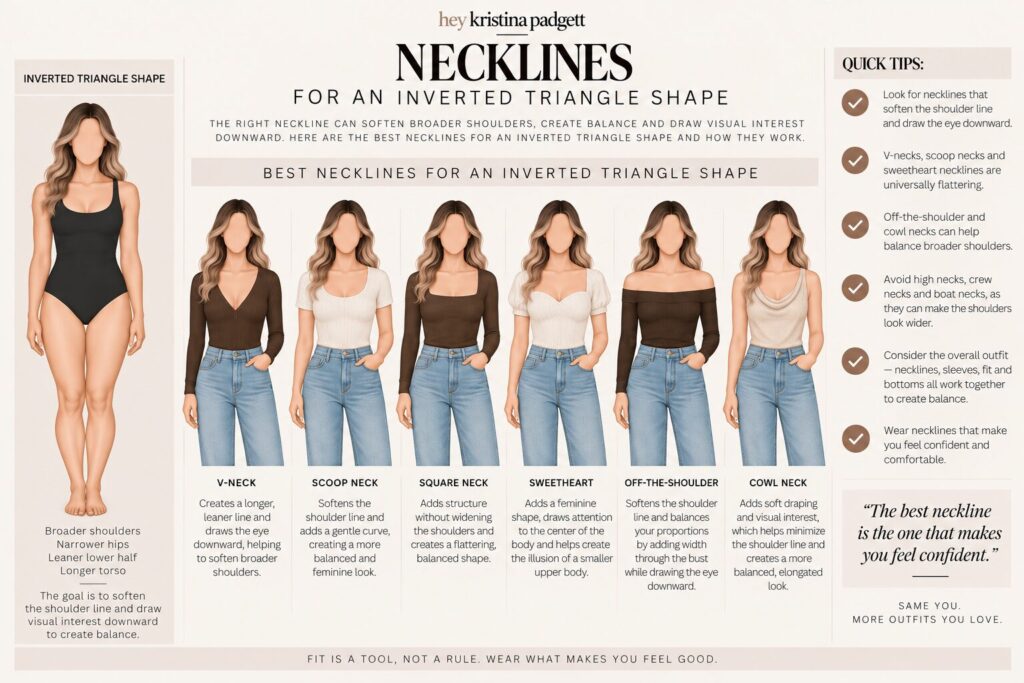
Necklines are one of those small styling details that can make a surprisingly big difference.
If you want to create more vertical space through your upper body, try:
V-necks
Scoop necks
Open button-downs
Soft square necklines
Wrap-style necklines
These create different visual lines from:
Boat necks
High crewnecks
Off-the-shoulder styles
Wider necklines can emphasize horizontal width through the upper body.
More open or vertical necklines can create a different effect.
But this doesn’t mean:
“Inverted triangles can’t wear boat necks.”
Nothing in this guide is forbidden.
If you love your shoulders, a boat neck or off-the-shoulder top might be exactly what you want.
We’re learning what the neckline does, not deciding whether you’re allowed to wear it.
8. Dresses Don’t Need to Hide Your Shoulders
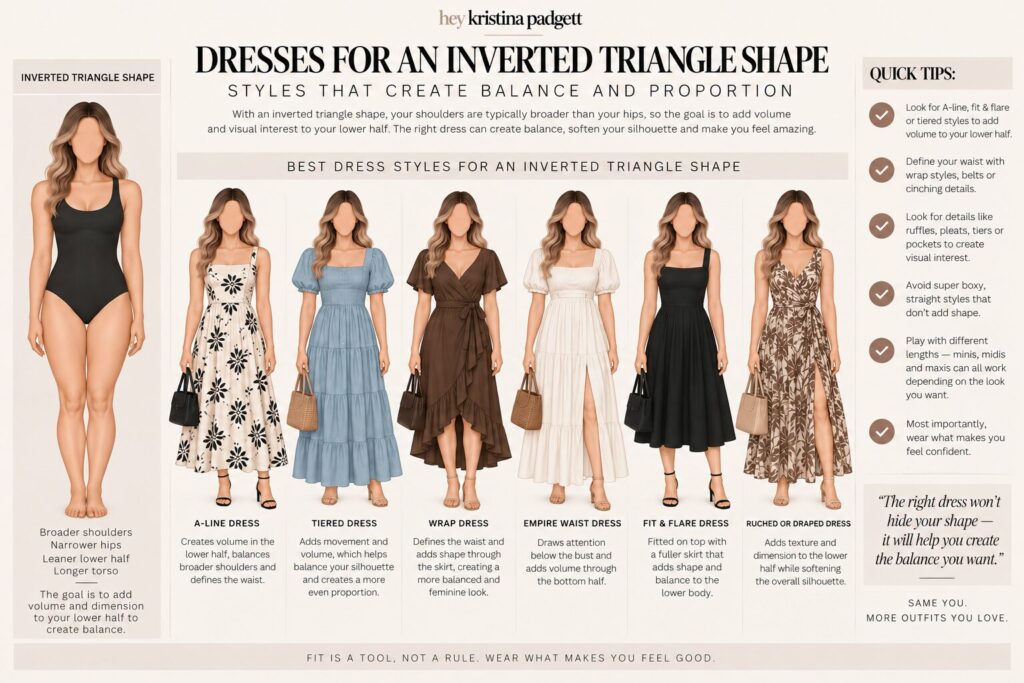
You don’t need to shop for dresses based on which ones make your upper body look smallest.
Instead, look at the entire silhouette.
Try experimenting with:
A-line dresses
Wrap dresses
Fit-and-flare dresses
Structured shirt dresses
Bias-cut dresses
Drop-waist dresses
An A-line or fit-and-flare dress can introduce more volume through the lower half.
A wrap dress can create diagonal lines through the torso.
A straighter dress can lean into your natural proportions.
But here’s the important part:
Don’t shop by silhouette name alone.
Look at:
Where the waist hits.
Where the skirt begins to widen.
How the shoulder is constructed.
Where the dress ends.
Two “A-line dresses” can fit the exact same woman completely differently.
Your individual proportions finish the job.
Easy Outfit Formulas for an Inverted Triangle Body Shape
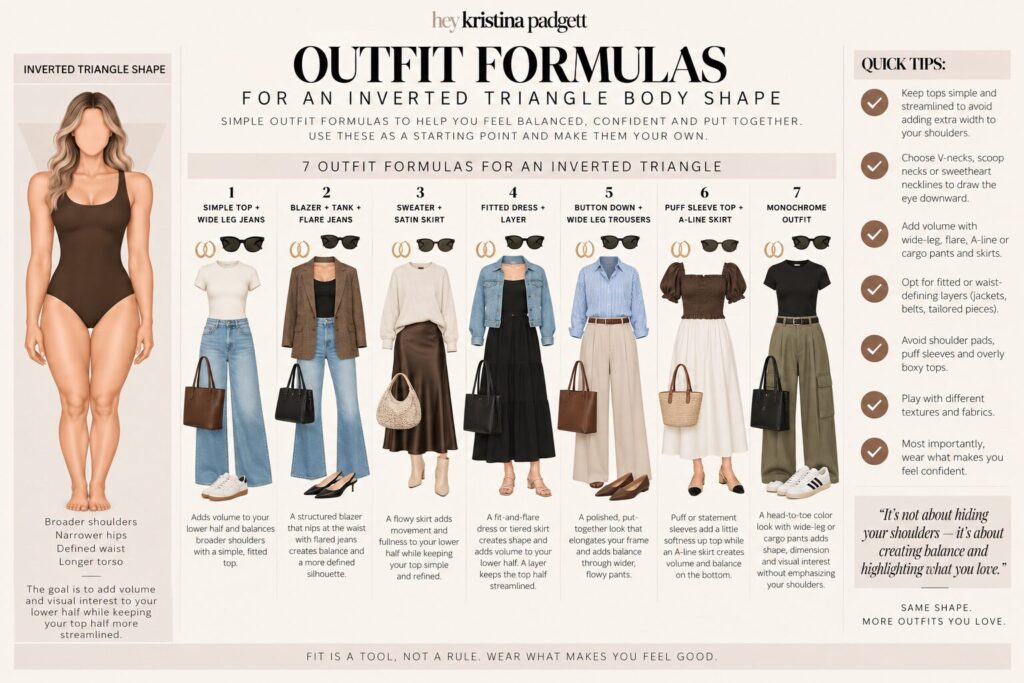
If you don’t want to analyze every outfit, start with a few formulas.
Outfit Formula #1
V-neck sweater + wide-leg jeans + loafer
The open neckline creates a vertical line while the denim adds visual weight through the lower half.
Outfit Formula #2
Fitted tee + barrel jeans + sneaker
Simple up top with shape and volume through the denim.
Outfit Formula #3
Open button-down + tank + wide-straight jeans + pointed flat
The open shirt creates vertical lines while the wider denim changes the overall silhouette.
Outfit Formula #4
Soft knit + A-line midi skirt + ankle boot
Movement through the skirt creates more visual interest below.
Outfit Formula #5
Waist-length jacket + fitted tee + bootcut jeans + loafer
The shorter jacket lets the shape of the denim do more of the proportion work.
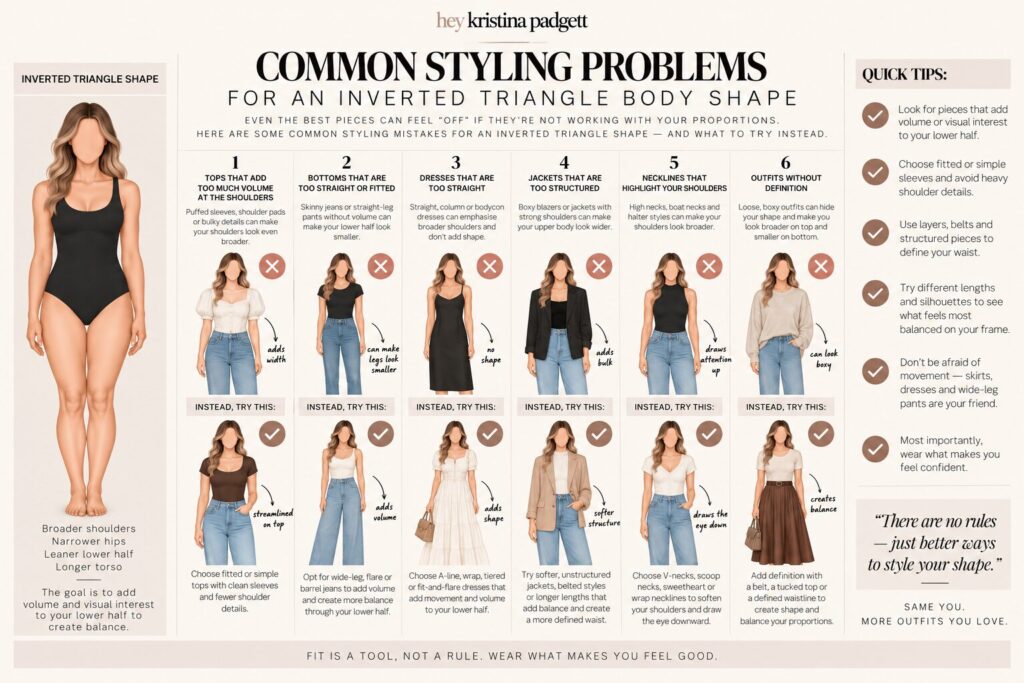
Common Inverted-Triangle Styling Problems — and What I’d Try Instead
If an outfit feels off, don’t immediately decide:
“I can’t wear that because of my shoulders.”
Troubleshoot it.
Your upper body feels visually heavy?
Try adding volume through your pants or skirt.
Your shoulders feel more prominent than you wanted?
Look at the shoulder seam, sleeve construction and neckline.
Your legs feel too narrow compared with your top?
Try a wider or more dimensional denim silhouette.
Your torso feels short?
Experiment with rise, neckline and top length.
Your jacket feels overwhelming?
Look at the shoulder structure AND where the hem hits.
Everything feels top-heavy?
Before making your top smaller, try making your bottom slightly fuller.
Sometimes changing one proportion fixes the entire outfit.
If You’re Petite AND Inverted-Triangle Shaped
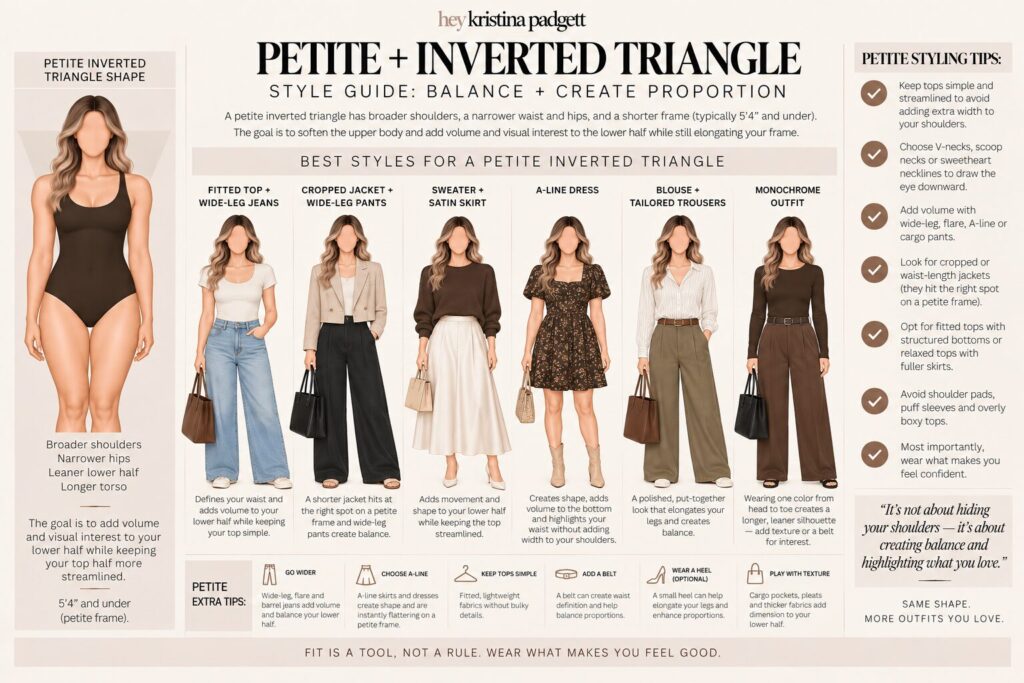
This deserves its own section because I’m petite too, and height adds another layer to everything we’re talking about.
Being petite does not mean you can’t wear wide-leg jeans, oversized blazers, full skirts or maxi dresses.
It means scale matters.
A petite inverted triangle may need:
Less overall leg volume
The correct inseam
A waistband that lands at the right place
A shorter or more intentional top length
Jackets with appropriately scaled shoulders
Volume that doesn’t overwhelm your frame
For example, wide-leg jeans may be exactly what you want to add visual weight below.
But there’s a difference between:
Subtle wide leg → wide straight → dramatically oversized wide leg
You may love one and feel swallowed by another.
That doesn’t mean:
“Petites can’t wear wide-leg jeans.”
It means the proportions of that particular pair weren’t right for you.
THE PETITE GIRL’S GUIDE TO GETTING DRESSED
The Biggest Thing I Want You to Remember
Your body shape is a starting point—not a set of rules.
Being an inverted triangle doesn’t mean:
You need to hide your shoulders.
You can’t wear puff sleeves.
You have to wear wide-leg pants.
You can’t wear skinny jeans.
You need to create bigger-looking hips.
You should avoid certain necklines.
It simply gives you information about your natural proportions.
Then we add:
Height.
Torso length.
Leg length.
Rise.
Garment length.
Shoulder construction.
Personal style.
That’s where getting dressed becomes much more individualized.
The goal isn’t to make every inverted triangle look hourglass.
The goal is to understand why an outfit creates the silhouette it does—so you can decide whether that’s the silhouette you want.