

If you’ve ever tried on an outfit that looked amazing on someone else and thought, “Why does this look completely different on me?” — your body shape might have something to do with it.
And no, figuring out your body shape isn’t about deciding whether your body is “good” or “bad.”
It’s about proportions.
Where are you naturally wider? Where are you narrower? Is your waist defined? How are your shoulders proportioned to your hips?
Once you understand those things, getting dressed gets a whole lot easier.
Instead of constantly asking:
“Is this flattering?”
I want you to start asking:
“Does this work with my proportions?”
Because those are two very different questions.
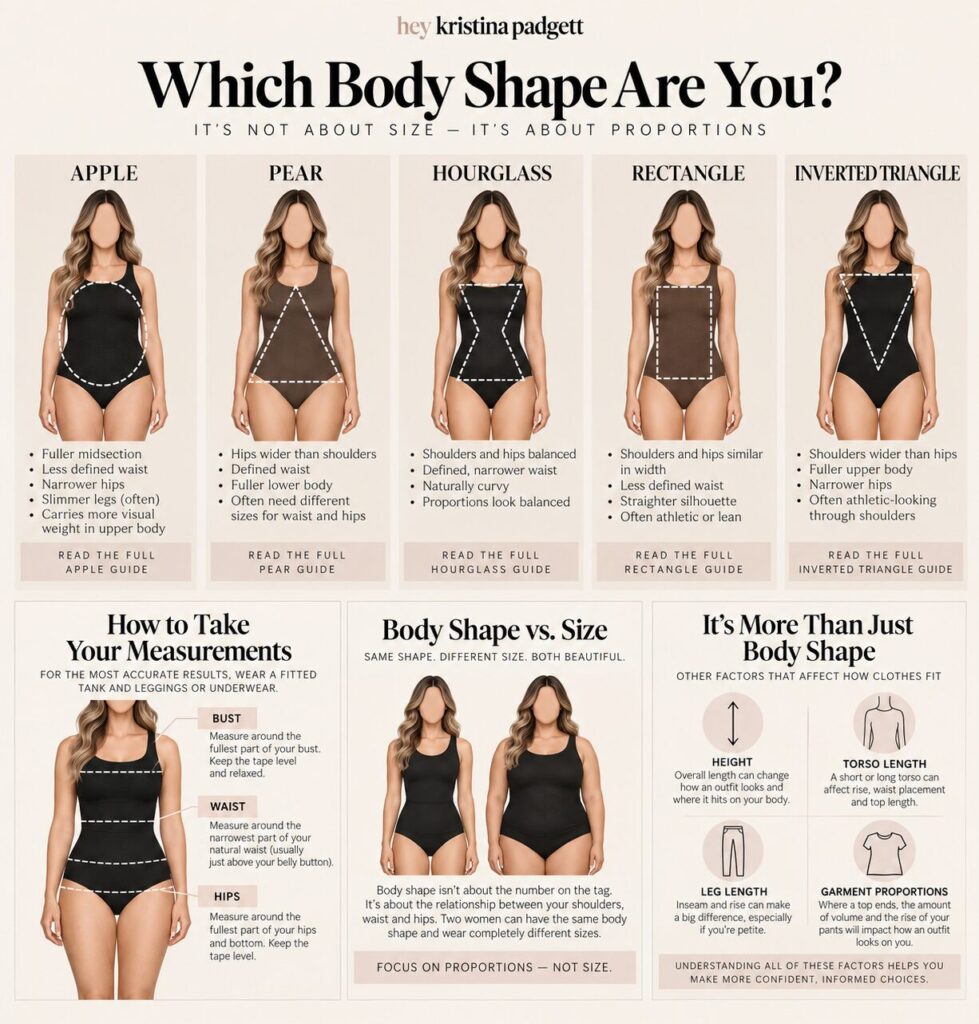
First: What Is a Body Shape?
When we talk about body shapes in styling, we’re usually looking at the relationship between three areas:
- Your shoulders/bust
- Your waist
- Your hips
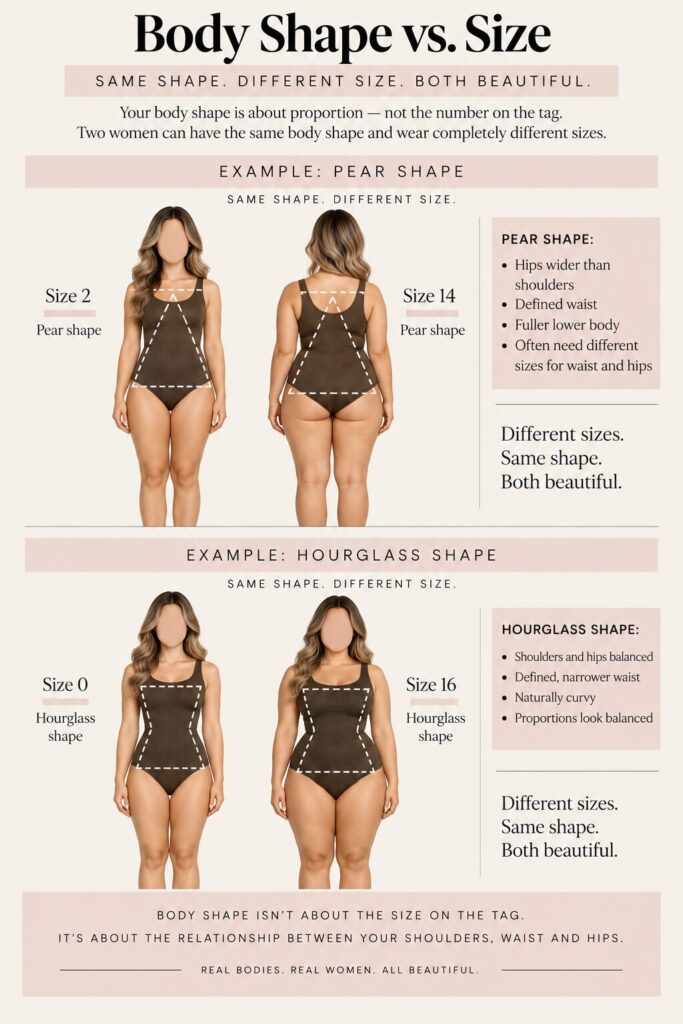
Your weight doesn’t determine your body shape.
Two women who wear completely different sizes can have the same body shape because we’re looking at proportion — not size.
You can also gain or lose weight and still maintain many of the same underlying proportions.
The five body shapes I use most often are:
Apple
Pear
Hourglass
Rectangle
Inverted Triangle
You may not fit perfectly into one category, either.
That’s normal.
Body shapes are a styling tool, not a rulebook. The goal isn’t to force your body into a label. The goal is to understand why certain clothes behave differently on your frame.
How to Determine Your Body Shape
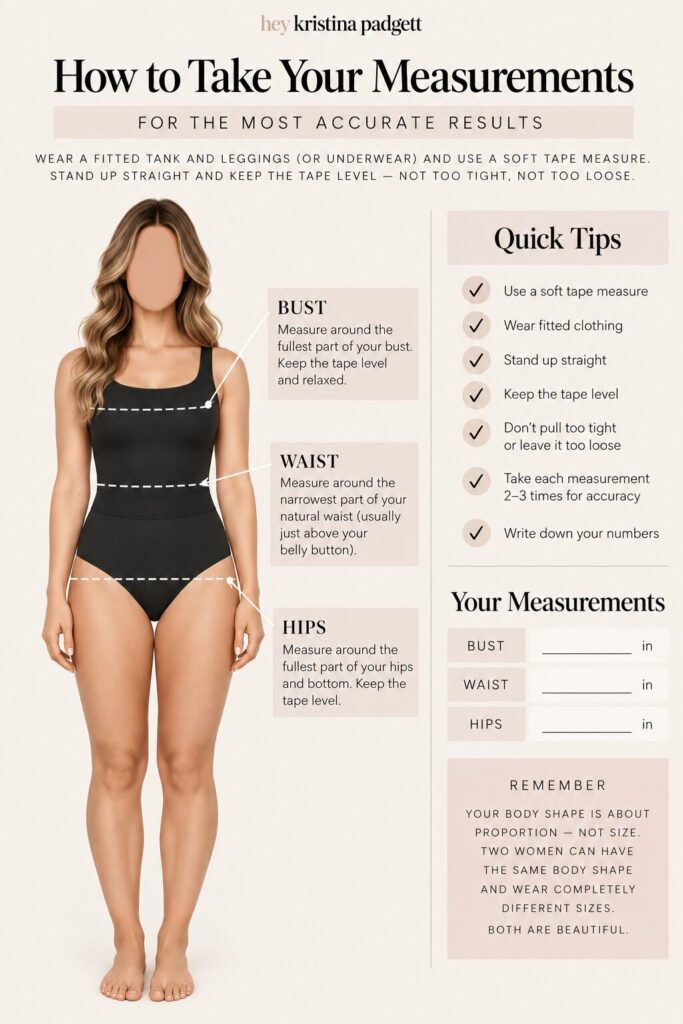
You can start by standing in front of a mirror wearing something fitted — leggings and a fitted tank work perfectly.
Look at your shoulders, waist and hips.
You can also take your measurements if you want a more objective comparison.
Measure around the fullest part of your bust, the narrowest part of your natural waist and the fullest part of your hips.
Then look at the relationship between those measurements.
Here’s what you’re looking for.
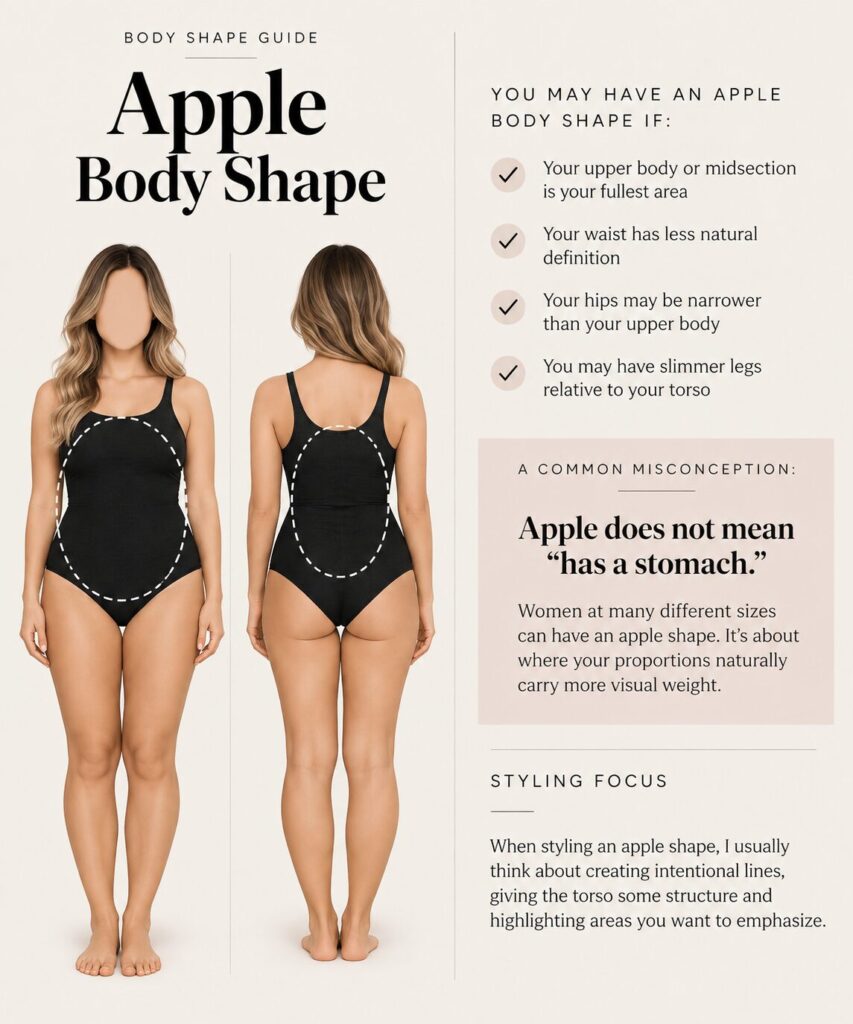
Apple Body Shape
You may have an apple body shape if:
- Your upper body or midsection is your fullest area
- Your waist has less natural definition
- Your hips may be narrower than your upper body
- You may have slimmer legs relative to your torso
One misconception I want to get rid of immediately:
Apple does not mean “has a stomach.”
Women at many different sizes can have an apple shape.
It’s about where your proportions naturally carry more visual weight.
When styling an apple shape, I usually think about creating intentional lines, giving the torso some structure and highlighting areas you want to emphasize.
→ READ NEXT: How to Dress an Apple Body Shape
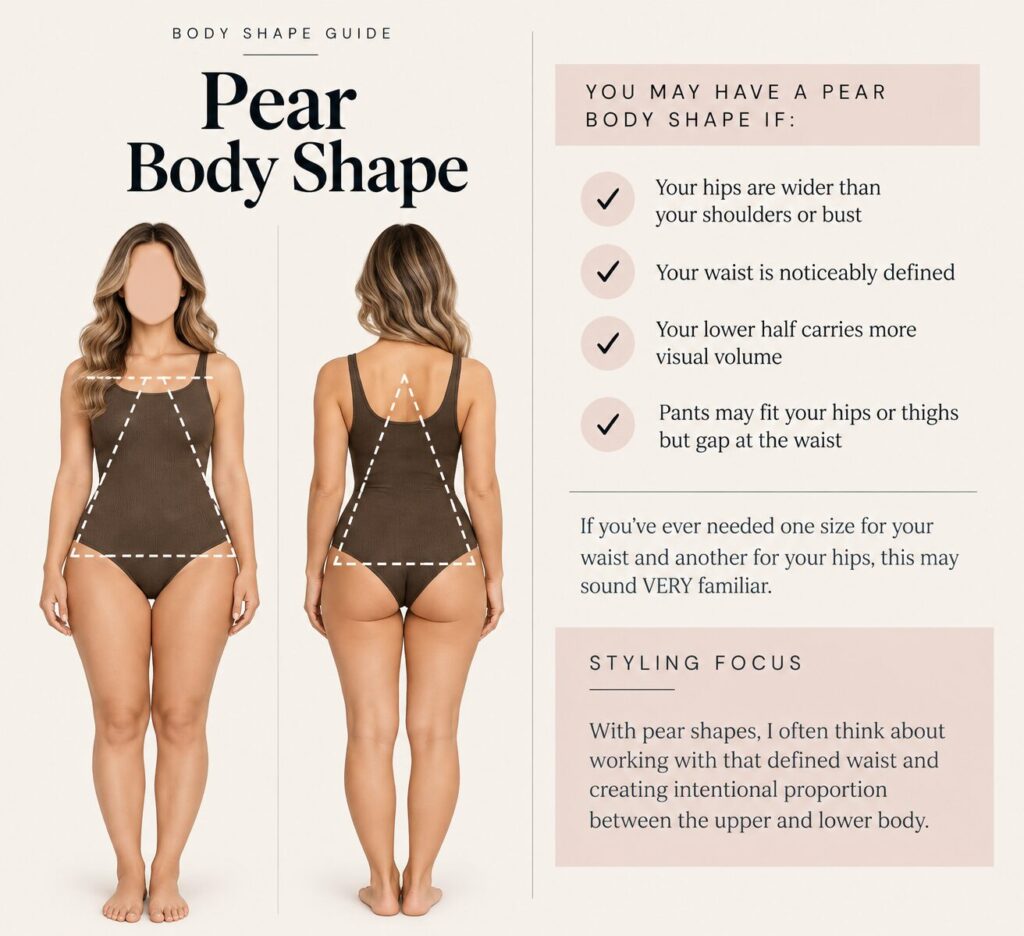
Pear Body Shape
You may have a pear body shape if:
- Your hips are wider than your shoulders or bust
- Your waist is noticeably defined
- Your lower half carries more visual volume
- Pants may fit your hips or thighs but gap at the waist
If you’ve ever needed one size for your waist and another for your hips, this may sound VERY familiar.
With pear shapes, I often think about working with that defined waist and creating intentional proportion between the upper and lower body.
→ READ NEXT: How to Dress a Pear Body Shape
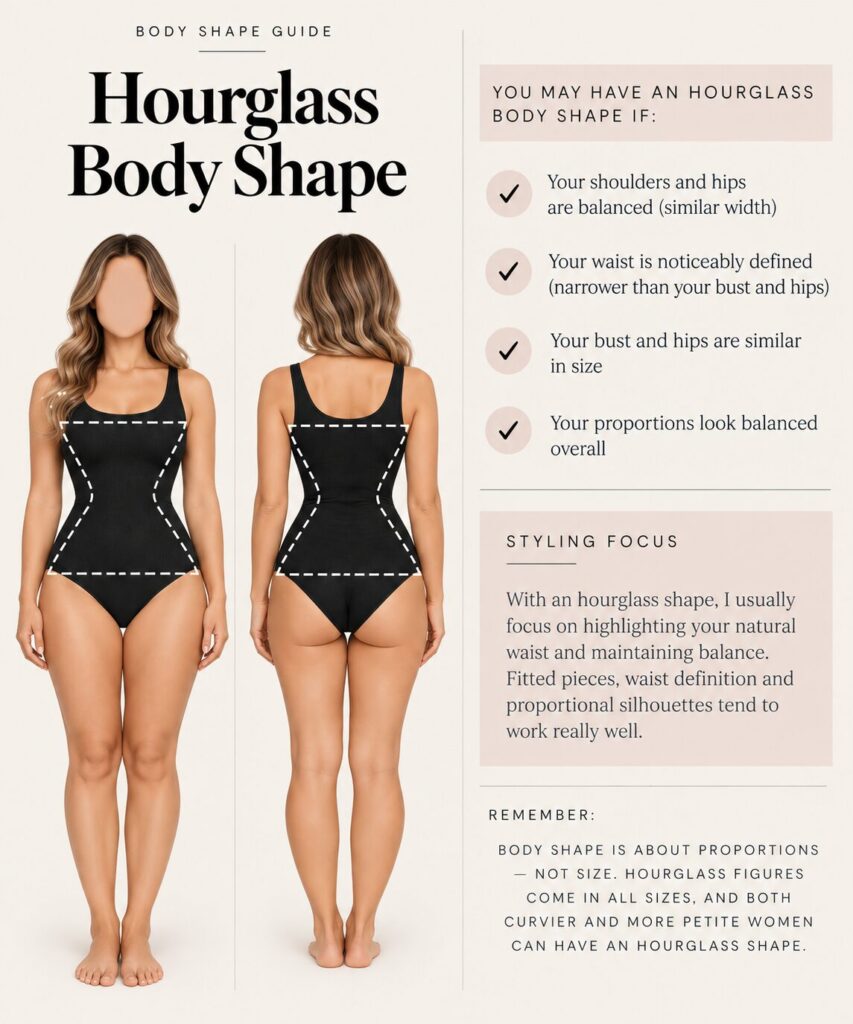
Hourglass Body Shape
You may have an hourglass body shape if:
- Your shoulders/bust and hips are relatively balanced
- Your waist is noticeably smaller
- Your body naturally creates a defined waistline
- Clothes that completely hide your waist can sometimes make you feel visually wider than you are
The biggest styling mistake I see with hourglass shapes isn’t wearing the “wrong” trend.
It’s simply losing all of the natural definition that’s already there.
That doesn’t mean everything needs to be tight.
It means understanding where a garment creates — or removes — shape.
→ READ NEXT: How to Dress an Hourglass Body Shape
Rectangle Body Shape
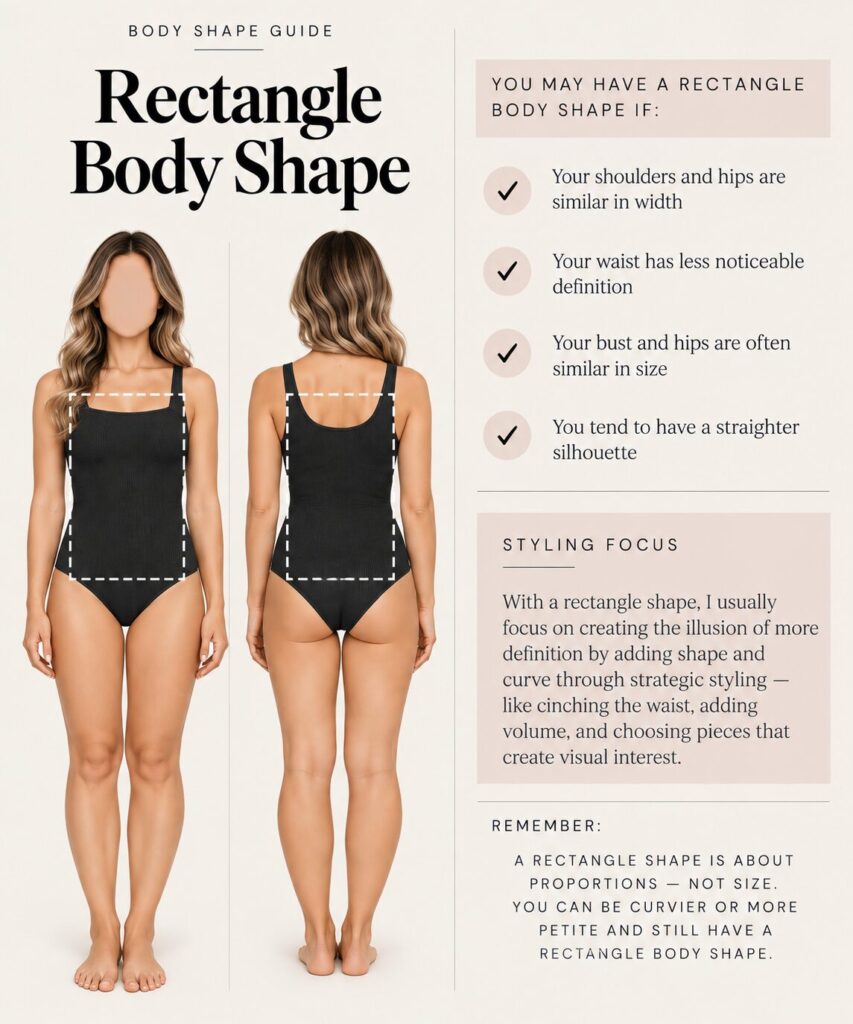
You may have a rectangle body shape if:
- Your shoulders and hips are relatively similar in width
- Your waist has less dramatic definition
- Your proportions look fairly straight from shoulder to hip
- You may have an athletic or straighter frame
Rectangle shapes have SO many styling options.
Depending on the outfit, you can choose to emphasize your naturally straight silhouette or use clothing to create more definition.
This is where things like waist placement, jacket length, volume and tucking can completely change an outfit.
→ READ NEXT: How to Dress a Rectangle Body Shape
Inverted Triangle Body Shape
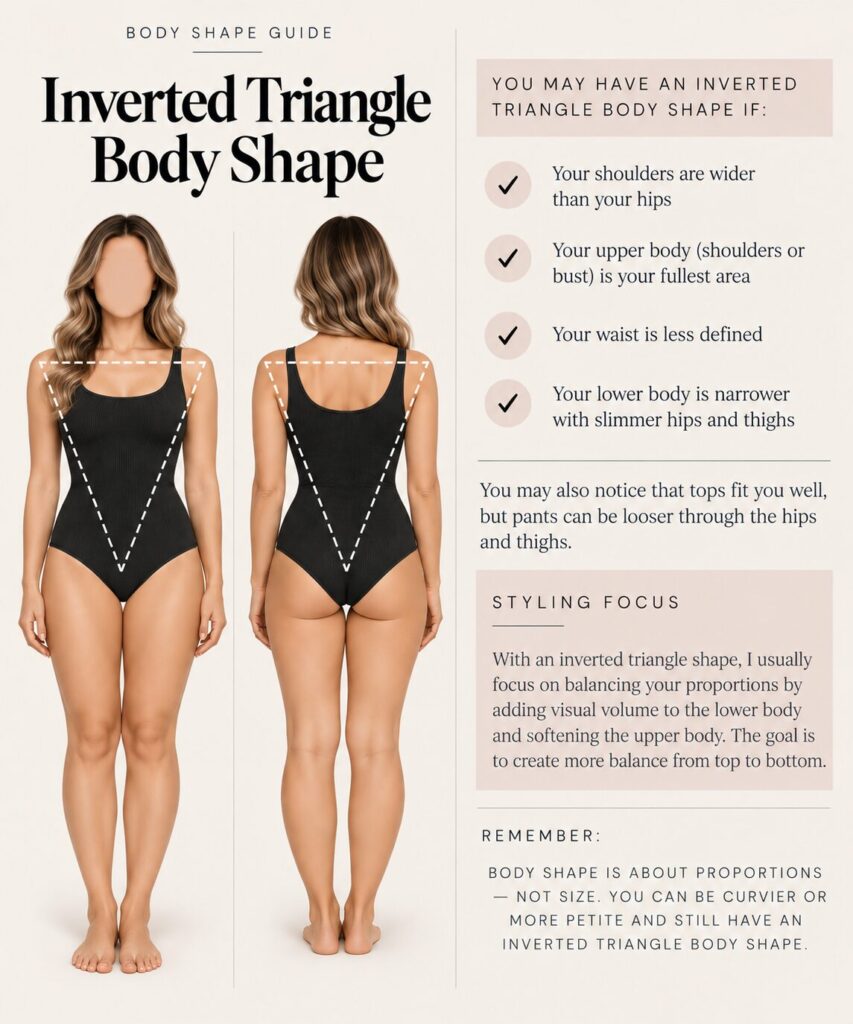
You may have an inverted triangle body shape if:
- Your shoulders are wider than your hips
- Your upper body carries more visual width
- Your hips and lower body may appear narrower
- You may naturally have broader or more athletic-looking shoulders
When dressing an inverted triangle shape, I often think about where we’re adding visual volume.
For example, a wider-leg jean can add visual weight to the lower half and create a completely different proportion than a very skinny pant.
→ READ NEXT: How to Dress an Inverted Triangle Body Shape
What If I Can’t Tell My Body Shape?
This is probably more common than you think.
You might look at the descriptions and think:
“Okay…I’m kind of a rectangle but also maybe an apple?”
That’s totally possible.
Real bodies don’t come in five perfectly defined categories.
If you’re between two shapes, don’t obsess over choosing the “correct” one.
Instead, look at the characteristics you identify with.
Maybe you have relatively balanced shoulders and hips like a rectangle, but you carry more fullness through your middle.
Great.
Now we know two useful things about your proportions.
That’s much more helpful than forcing yourself into one category.
Body Shape Isn’t the Only Thing That Matters
This is REALLY important.
Knowing your body shape isn’t going to magically explain why every piece of clothing looks the way it does.
Two women can both be pear shapes and look completely different in the same jeans.
Why?
Because we also have to consider things like:
Height.
Torso length.
Leg length.
Rise.
Inseam.
Where a top ends.
Where your waist actually sits.
The amount of volume in a garment.
This is especially important if you’re petite.
I’m 5’2″, so I pay a LOT of attention to proportions when I get dressed.
Sometimes the issue isn’t that a trend “doesn’t work” on a petite body.
The proportions of that particular garment just aren’t working.
A jacket might be too long.
The rise might hit at the wrong place.
A wide-leg jean might simply have too much volume.
A sweater might extend several inches too far past your hips.
Tiny changes can make a huge difference.
Why Knowing Your Body Shape Actually Helps
Here’s what I DON’T want you to do after reading this:
“I’m a pear, so I’m not allowed to wear ______.”
No.
Wear whatever you want.
Understanding your proportions isn’t about creating more fashion rules.
It’s about giving yourself more information.
If you put something on and love it?
Wear it.
But if you put something on and can’t figure out why the outfit feels slightly off, understanding your proportions gives you somewhere to start.
Maybe you need:
A different rise.
A shorter top.
More volume on the bottom.
Less volume on the bottom.
A more defined waist.
A different jacket length.
A different inseam.
That’s a much more useful conversation than simply deciding:
“That doesn’t look good on my body.”
The Question I Want You to Start Asking
The next time you get dressed, don’t immediately ask:
“Does this make me look skinny?”
Or even:
“Is this flattering?”
Instead ask:
“What are the proportions of this outfit doing?”
Where does the top end?
Where does the waistband hit?
Where is the widest part of the outfit?
Is my waist visible or intentionally undefined?
Does the volume feel balanced?
Do my legs look visually longer or shorter?
Once you start noticing those things, you’ll begin understanding why you like certain outfits instead of just knowing that you do.
And THAT is when getting dressed starts becoming easier.
Start Here
Now that you have an idea of your body shape, the next step is learning how different silhouettes work with your proportions.
Choose your guide:
Apple → How to Dress an Apple Body Shape
Pear → How to Dress a Pear Body Shape
Hourglass → How to Dress an Hourglass Body Shape
Rectangle → How to Dress a Rectangle Body Shape
Inverted Triangle → How to Dress an Inverted Triangle Body Shape
And remember:
Your body shape isn’t a list of things you can’t wear.
It’s information you can use to understand your clothes — instead of blaming your body when an outfit doesn’t work.
Want More Help Getting Dressed?
I’m building an entire library around body shape, proportions, petite styling, denim and realistic outfit formulas for millennial women.
Join my email list and I’ll send the newest styling guides straight to your inbox.
[JOIN THE LIST]
And if there’s one category of clothing you can NEVER figure out for your body, tell me. Jeans? Dresses? Tops? Jackets?
I’m using your questions to decide what styling guides I create next.