

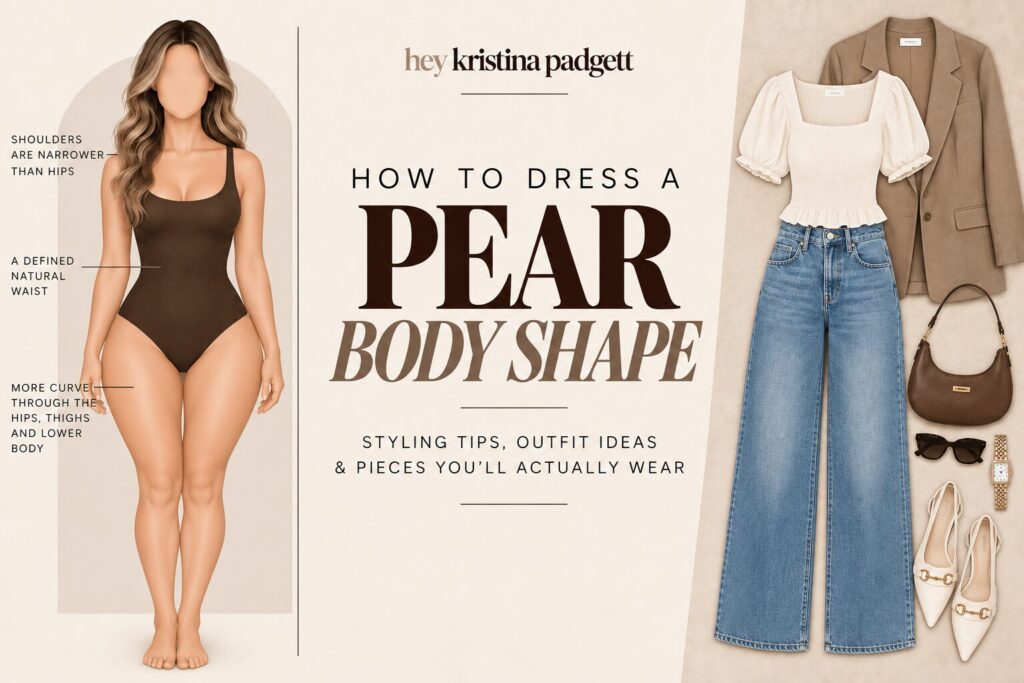
If you have a pear body shape, you’ve probably heard some version of this advice:
“Balance your hips.”
Or:
“Wear dark colors on the bottom.”
Or maybe:
“Avoid anything that makes your hips look wider.”
But I don’t think getting dressed should be about trying to make one part of your body look smaller.
Understanding your body shape is much more useful when you think of it as a way to understand proportion.
Why does one pair of jeans completely change the way an outfit looks?
Why does a cropped jacket work beautifully while another jacket feels slightly off?
Why does changing your neckline suddenly make an outfit feel more balanced?
Usually, it comes down to where your clothing is creating width, length, definition and visual weight.
And once you understand that, getting dressed gets a whole lot easier.
So instead of giving you a list of things pear shapes can and can’t wear, we’re going to talk about what different clothes actually do to your proportions.
Because ultimately:
Fit is a tool, not a rule.
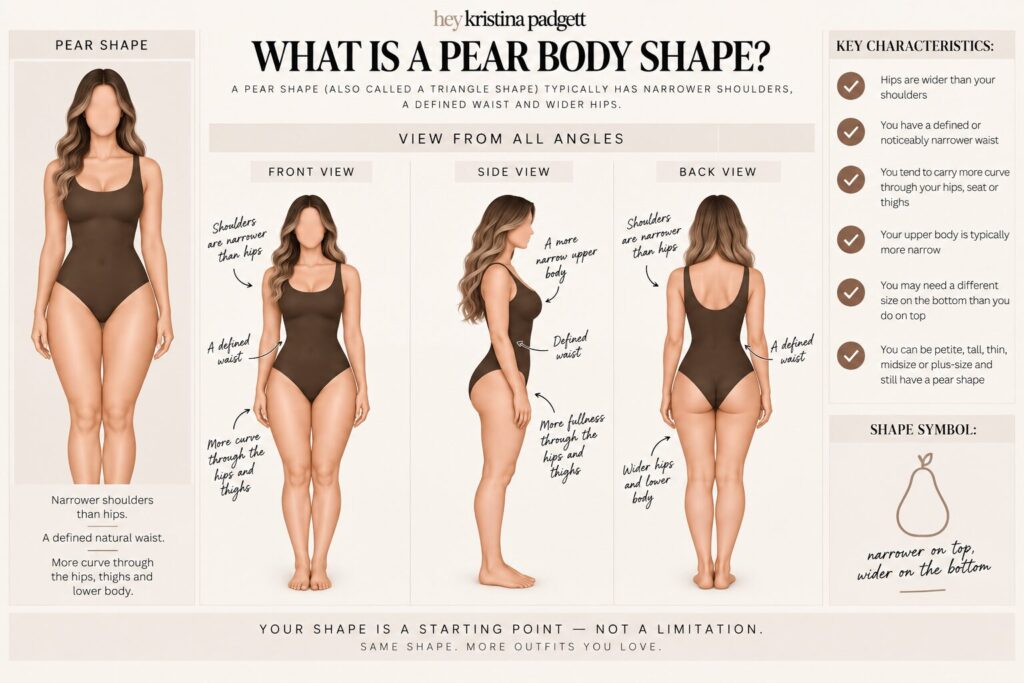
What Is a Pear Body Shape?
A pear body shape—sometimes called a triangle body shape—generally has more visual width through the lower body than the upper body.
Your hips may appear wider than your shoulders, and you may have a noticeable waist-to-hip transition.
Some common characteristics include:
Hips that are visually wider than the shoulders
A defined or noticeably narrower waist
More curve through the hips, seat or thighs
A comparatively narrower upper body
A tendency to need more room through the hips and thighs when buying bottoms
But these are characteristics—not requirements.
You don’t have to check every box to have pear proportions.
And body shape isn’t determined by your weight.
You can be petite, tall, thin, midsize or plus-size and have a pear shape.
The easiest thing to look at is the relationship between your shoulders, waist and hips.
If your lower body carries noticeably more visual width than your upper body, you’re probably working with pear proportions.
The Goal When Dressing a Pear Shape
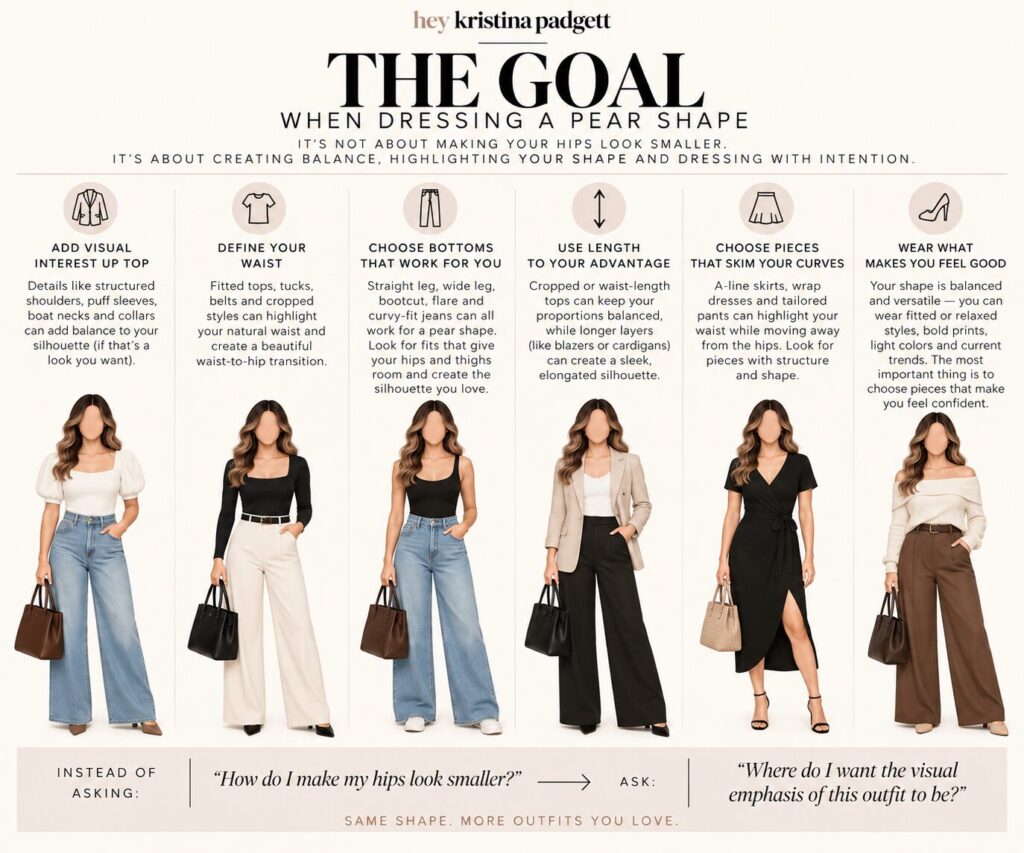
The goal is not to make your hips look smaller.
And it’s definitely not to hide your lower body.
Instead, think about this question:
Where do I want the visual weight of this outfit to sit?
Your clothing can completely change that.
You can emphasize your natural waist.
You can add visual interest to your upper body.
You can follow your curves.
You can create a straighter silhouette.
You can exaggerate the difference between your waist and hips.
You can create more visual width through your shoulders.
You can intentionally add even more volume to your lower body.
None of those choices is automatically better.
You’re simply deciding what silhouette you want to create.
1. Your Shoulder Line Can Change the Balance of Your Entire Outfit
Because a pear shape naturally has more visual width through the lower body, small changes around your shoulders can have a surprisingly big effect on your overall proportions.
Compare:
Simple fitted tank
Structured shoulder
Puff sleeve
Cap sleeve
Boat neck
Off-the-shoulder top
Your hips haven’t changed.
But the visual relationship between your upper and lower body has.
A simple fitted tank keeps your upper body relatively streamlined.
A puff sleeve creates additional volume around your shoulders.
A boat neck creates a stronger horizontal line across your upper body.
An off-the-shoulder neckline visually extends the shoulder line.
A structured blazer can add even more presence up top.
That doesn’t mean pear shapes need to make their shoulders look wider.
It simply means:
Shoulder detail is a styling tool.
If an outfit feels bottom-heavy and you want to change that balance, look at what’s happening around your shoulders before changing everything else.
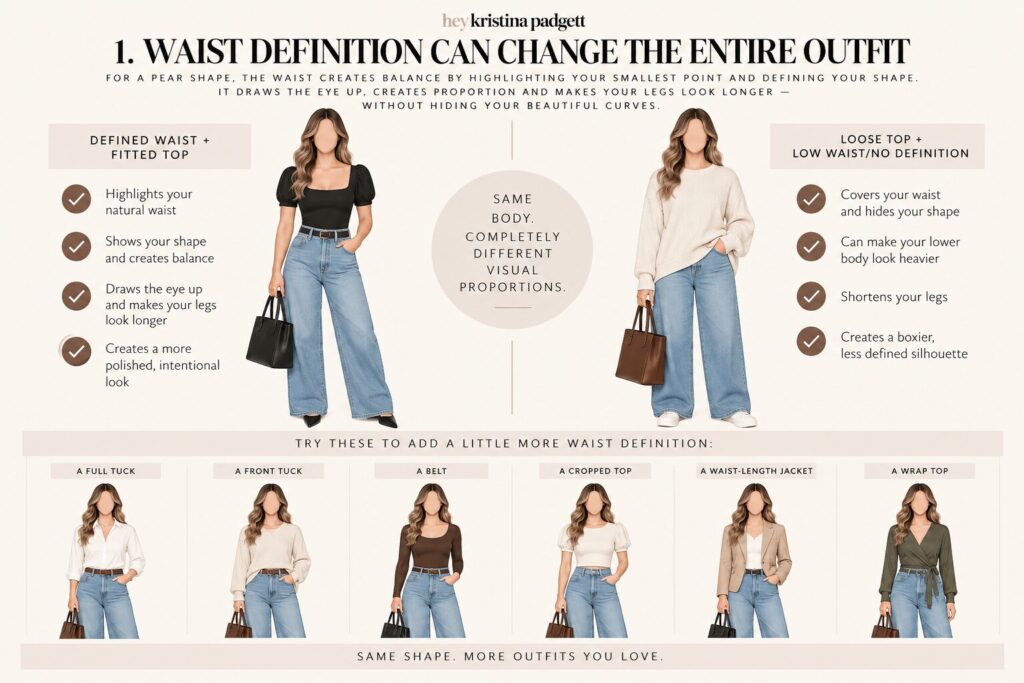
2. Waist Definition Can Completely Change Your Silhouette
Many pear shapes have a noticeable transition between their waist and hips.
Where your clothing sits in relation to that transition matters.
Compare:
Fitted top + high-rise jeans
with:
Oversized sweater + wide-leg jeans
Same body.
Completely different visual proportions.
The first allows your waist-to-hip transition to remain visible.
The second creates one longer, looser silhouette.
Neither is inherently better.
But if you’re wearing an oversized outfit and wondering why you suddenly feel overwhelmed by your clothes, try revealing even a small amount of your natural waist.
Experiment with:
A full tuck
A front tuck
A waist-length sweater
A cropped jacket
A belt
A fitted knit
A wrap silhouette
Sometimes showing only a few inches of waistband is enough to completely change the outfit.
3. Pay Attention to Where Your Tops End
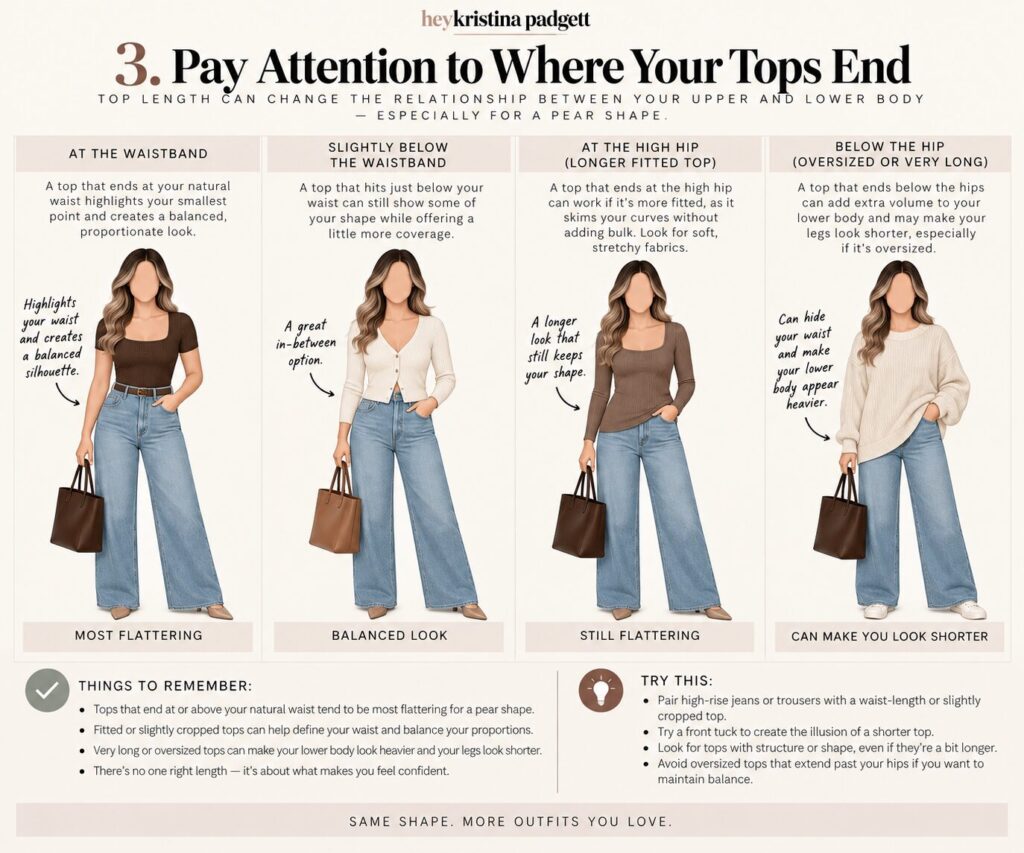
Top length can be especially noticeable on a pear shape.
Imagine a shirt ending directly at the fullest part of your hip.
Now imagine that same shirt ending at your waistband.
The clothes may only differ by a few inches, but the resulting silhouette can look completely different.
Experiment with tops ending:
At the waistband
Just below the waistband
At the upper hip
At the fullest part of the hip
Below the hip
A shorter top keeps more of your waist and lower-body shape visible.
A longer top can visually smooth the transition between your waist and hips and create a straighter outer line.
Again:
Neither is wrong.
You’re choosing the silhouette.
This is especially helpful to remember with:
Oversized sweaters
Button-down shirts
T-shirts
Blazers
Cardigans
Before deciding a top isn’t flattering, experiment with where it ends.
Sometimes folding the bottom of a sweater underneath itself completely fixes the outfit.
4. Fit Your Hips First
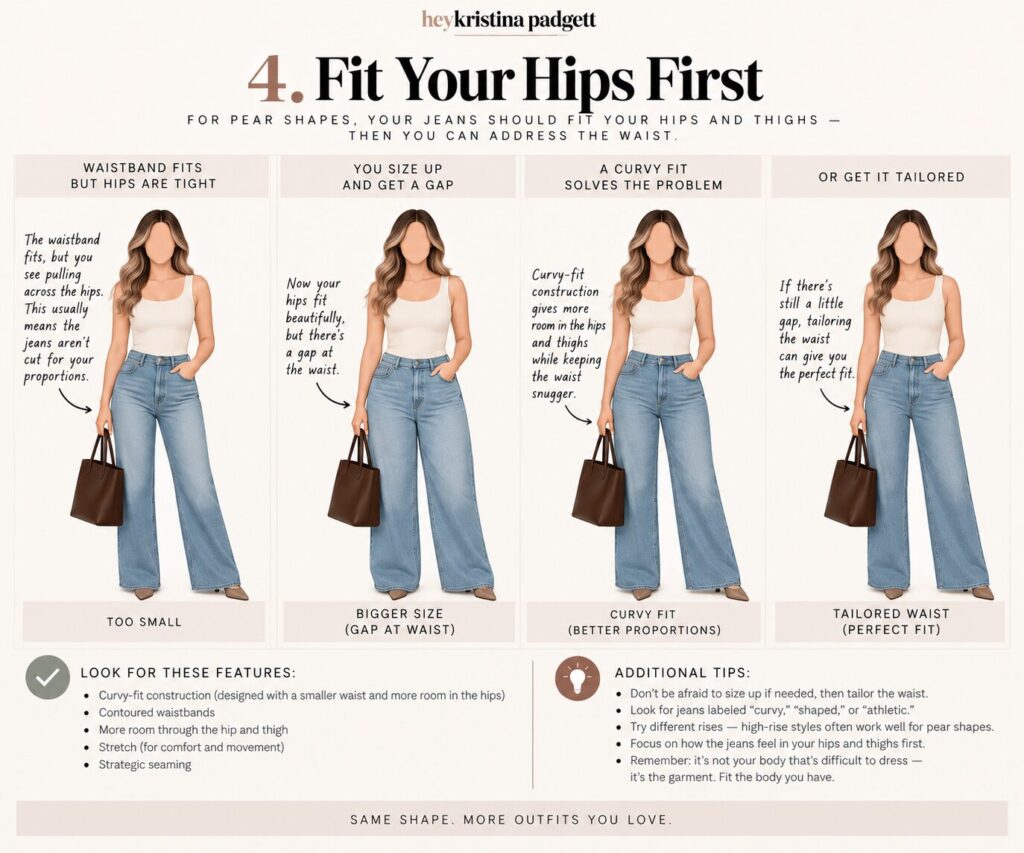
This may be one of the most important shopping lessons for pear shapes.
You try on jeans.
The waistband fits perfectly.
But they’re pulling across your hips.
So you size up.
Now your hips fit beautifully…
and there’s a giant gap at the waist.
Sound familiar?
That doesn’t mean your body is difficult to dress.
It means the garment isn’t cut for your proportions.
Look for jeans and trousers with:
Curvy-fit construction
Contoured waistbands
More room through the hip and thigh
Stretch
Strategic seaming
And don’t underestimate tailoring.
Sometimes the best solution is buying pants that properly fit the fullest part of your body and having the waist taken in.
Fit the body you have rather than trying to force your proportions into the garment.
5. The Best Jeans for a Pear Body Shape
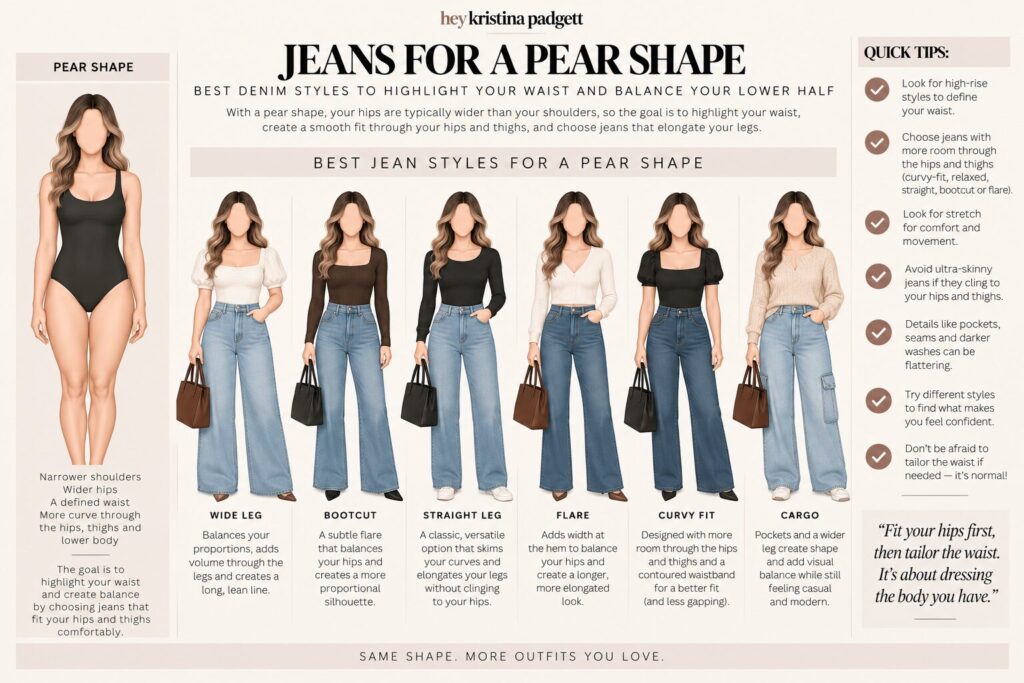
There isn’t one magical pair of jeans that every pear-shaped woman needs.
Different denim cuts simply create different silhouettes.
Straight Leg
Straight-leg jeans can follow your hips before creating a cleaner, straighter line down the leg.
Wide Leg
Wide-leg jeans carry more width downward from your hips, creating a longer continuous silhouette.
They’re also great when you simply want more room through your hips and thighs.
Bootcut
Bootcut jeans follow your hips and thighs before adding subtle width near the ankle.
That slight flare changes the visual relationship between your hips and hem.
Flare
Flare jeans create even more volume toward the bottom of the leg.
This can exaggerate curves while creating a dramatic, intentional silhouette.
Relaxed or 90s Straight
A relaxed straight jean gives you more room through the hips and thighs while maintaining a relatively straight leg.
Barrel
Barrel jeans intentionally add volume through the leg.
Instead of following your natural silhouette, they create an entirely new shape.
And yes:
Pear shapes can absolutely wear barrel jeans.
The question isn’t:
“Can I wear these?”
The better question is:
“Do I like the silhouette these create?”
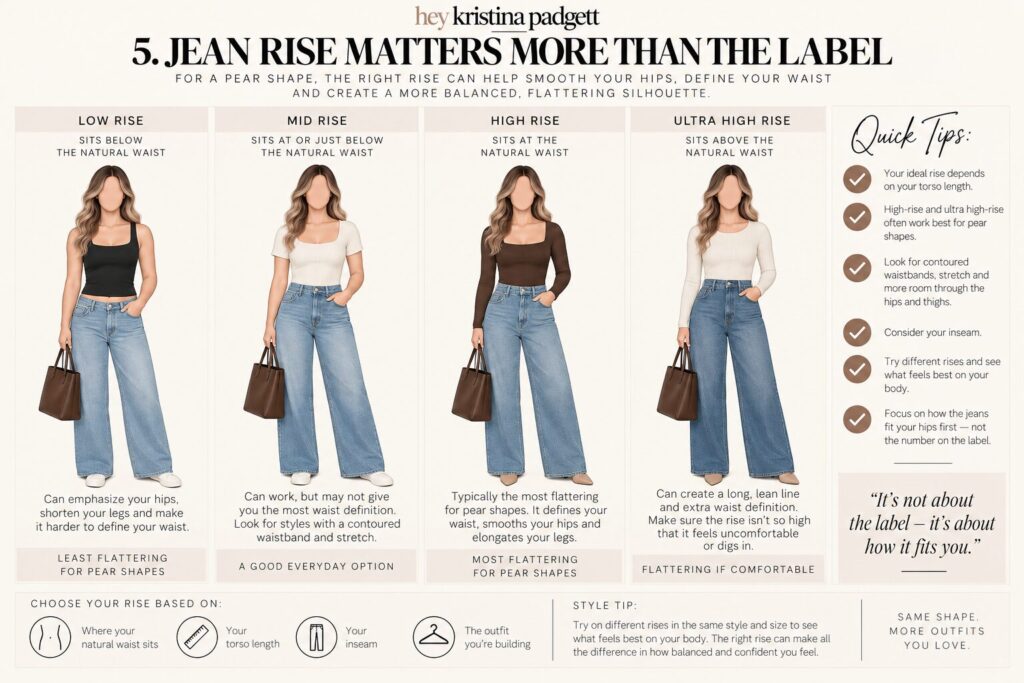
6. Jean Rise Matters More Than Your Body-Shape Label
Pear shape does not automatically mean high-rise.
Your ideal rise depends heavily on your torso length.
High Rise
High-rise jeans can emphasize your natural waist and visually lengthen your legs.
Mid Rise
Mid-rise jeans often create a very natural break through the torso and can be especially helpful if you’re short-waisted.
Low Rise
Low-rise jeans visually lengthen the torso and create a very different waist-to-hip proportion.
Ultra High Rise
Ultra-high-rise jeans can dramatically emphasize your waist but may feel overwhelming if you have a very short torso.
Don’t choose your rise because someone told you pear shapes need high-waisted jeans.
Choose it based on:
Where your natural waist sits
Your torso length
Your inseam
The silhouette you’re trying to create
7. Jackets Can Completely Change Your Shape
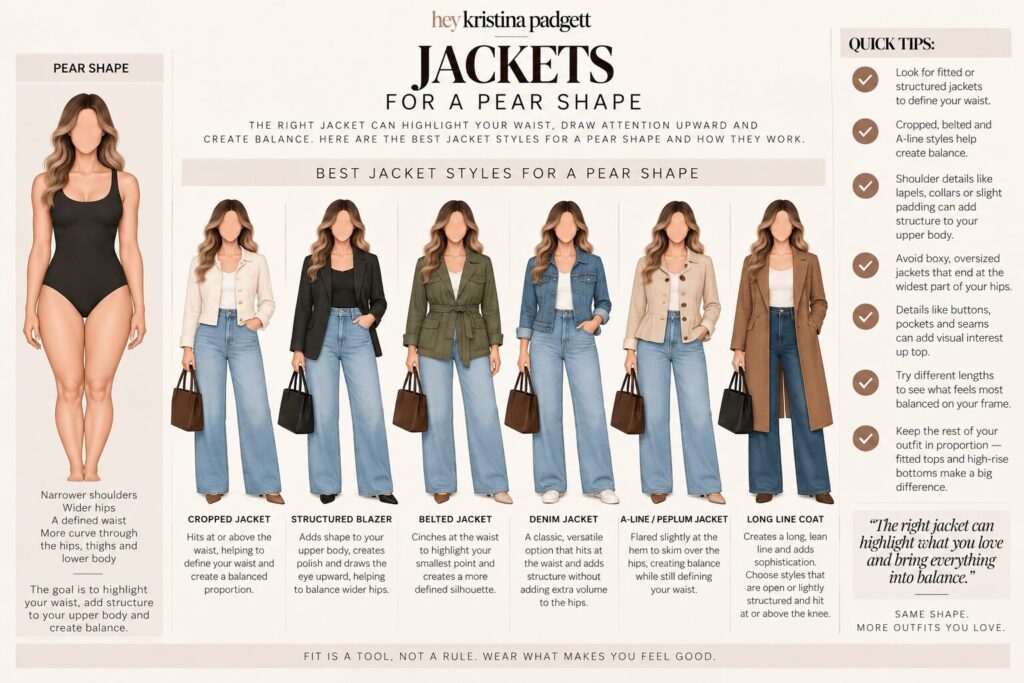
Jackets are one of my favorite ways to demonstrate proportion because changing only the jacket can make the same outfit look completely different.
Try comparing:
Cropped jacket
Waist-length blazer
Structured blazer
Belted jacket
Classic blazer
Longline blazer
Oversized jacket
A cropped or waist-length jacket keeps your natural waist-to-hip transition visible.
A structured blazer can add visual width through your upper body.
A belted jacket emphasizes your waist.
A longline blazer can visually smooth the transition between your waist and hips and create a straighter silhouette.
Pay special attention to where the jacket hem lands.
A jacket ending directly at the fullest part of your hip creates a different visual line than one ending slightly above or below it.
Sometimes changing the jacket length is all an outfit needs.
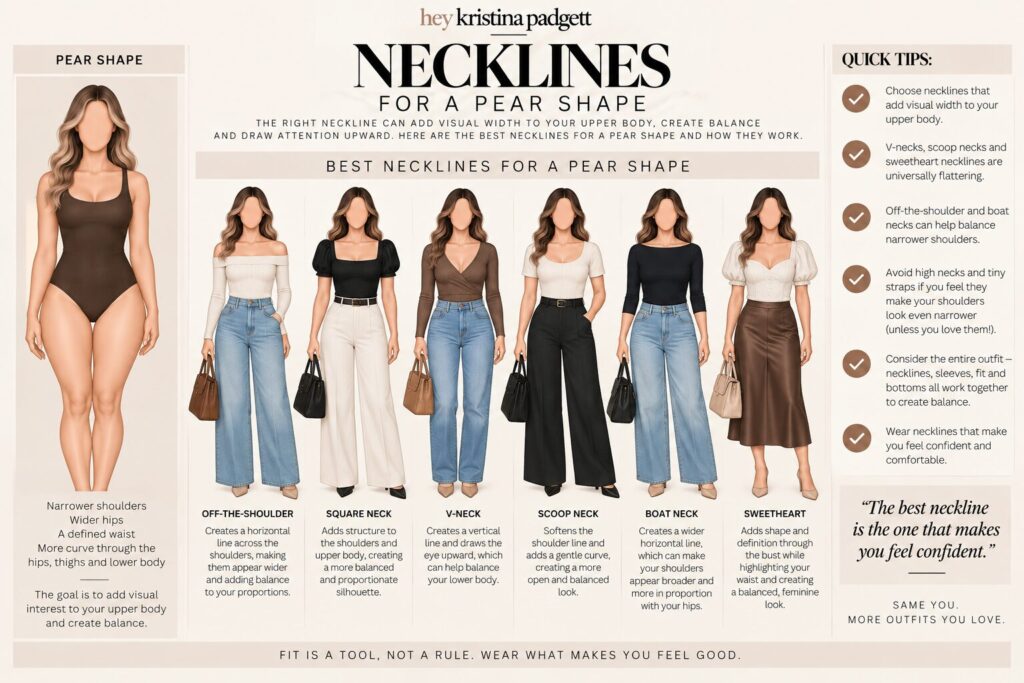
8. Necklines Can Change Your Upper-Body Proportions
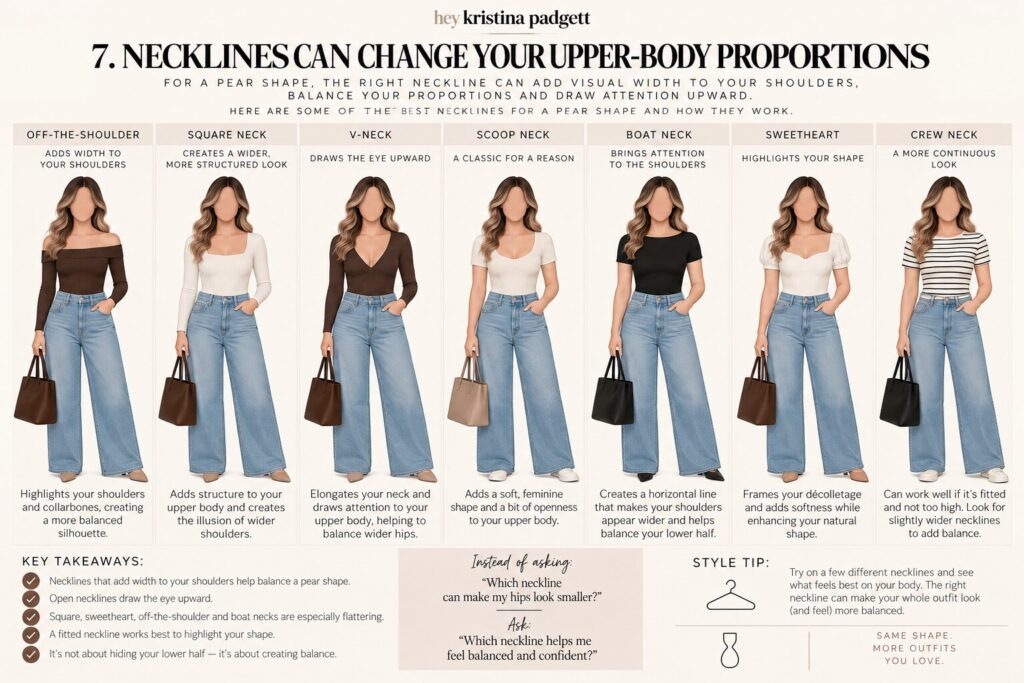
Your neckline affects the proportions of your upper body just as much as your pants affect your lower body.
Experiment with:
V-neck
Scoop neck
Square neck
Sweetheart
Crew neck
Boat neck
Off-the-shoulder
A V-neck creates a vertical line through your upper body.
A scoop neck creates openness around the chest.
A square neckline adds structure.
A sweetheart neckline creates definition around the bust and décolletage.
A boat neck creates a wider horizontal line.
An off-the-shoulder neckline visually extends your shoulder line even farther.
Don’t ask:
“Which neckline can a pear shape wear?”
Ask:
“What is this neckline doing to the proportions of my outfit?”
That’s a much more useful question.
The Best Dresses for a Pear Body Shape
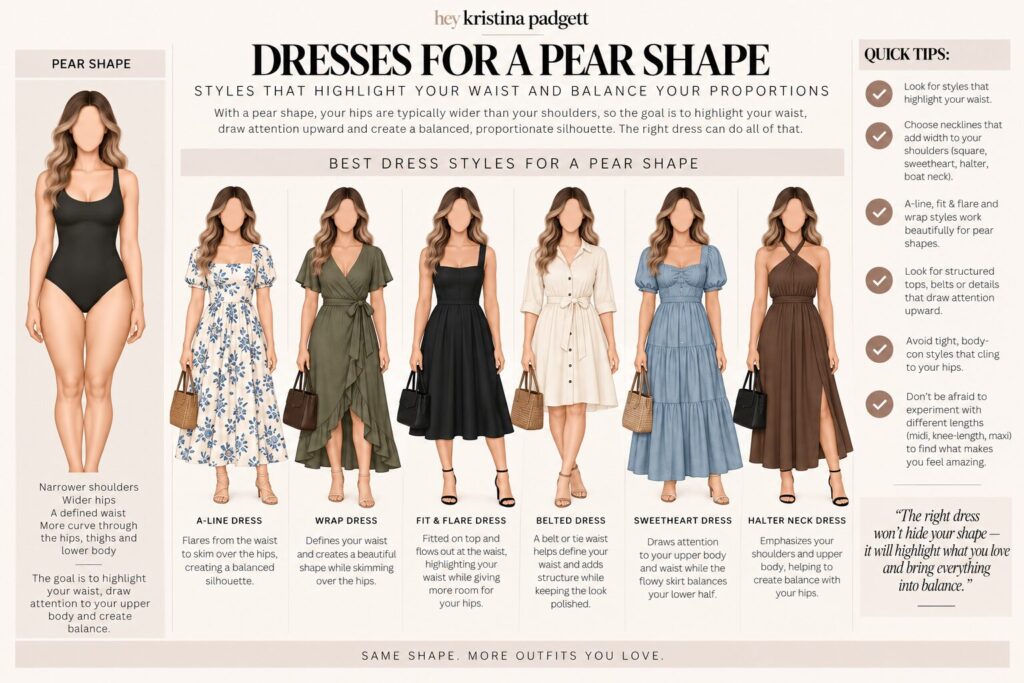
Dresses are another great example of why garment construction matters more than arbitrary body-shape rules.
A-Line Dresses
An A-line dress follows the upper body and gradually moves away from the hips.
Fit-and-Flare Dresses
Fit-and-flare styles emphasize the waist before adding volume below it.
Wrap Dresses
A wrap dress follows your natural curves while creating adjustable waist definition.
Belted Dresses
Belting allows you to control exactly where you create definition.
Bias-Cut Dresses
Bias-cut fabric can skim and follow curves rather than creating a rigid silhouette.
Slip Dresses
A slip dress creates a softer, more fluid line through the body.
Column Dresses
A straighter dress can visually reduce the contrast between your waist and hips and create a completely different silhouette.
Once again:
Your body hasn’t changed.
The garment architecture has.
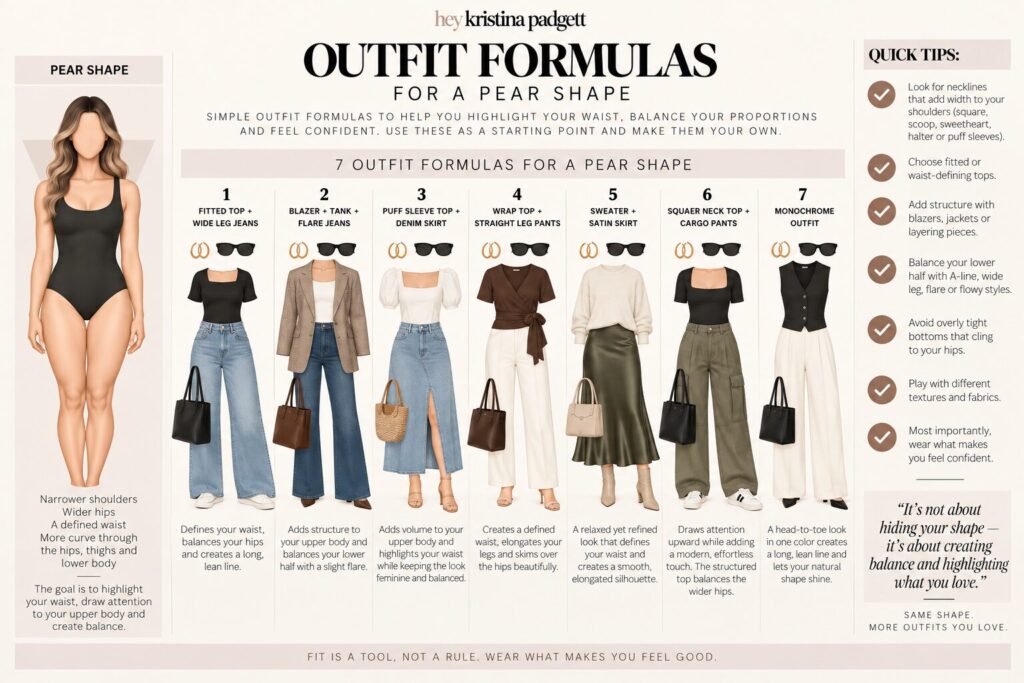
Easy Outfit Formulas for a Pear Shape
When you don’t know what to wear, having a few outfit formulas makes getting dressed significantly easier.
Try:
1. Boat-neck top + straight-leg jeans
2. Fitted knit + wide-leg trousers
3. Cropped cardigan + high-rise jeans
4. Structured blazer + fitted tank + relaxed denim
5. Fitted top + A-line midi skirt
6. Off-the-shoulder top + wide-leg pants
7. Wrap dress + simple accessories
Use these as starting points—not uniforms.
Swap the colors.
Change the shoes.
Add a jacket.
Change the rise.
Try a different neckline.
The formula simply gives you somewhere to start.
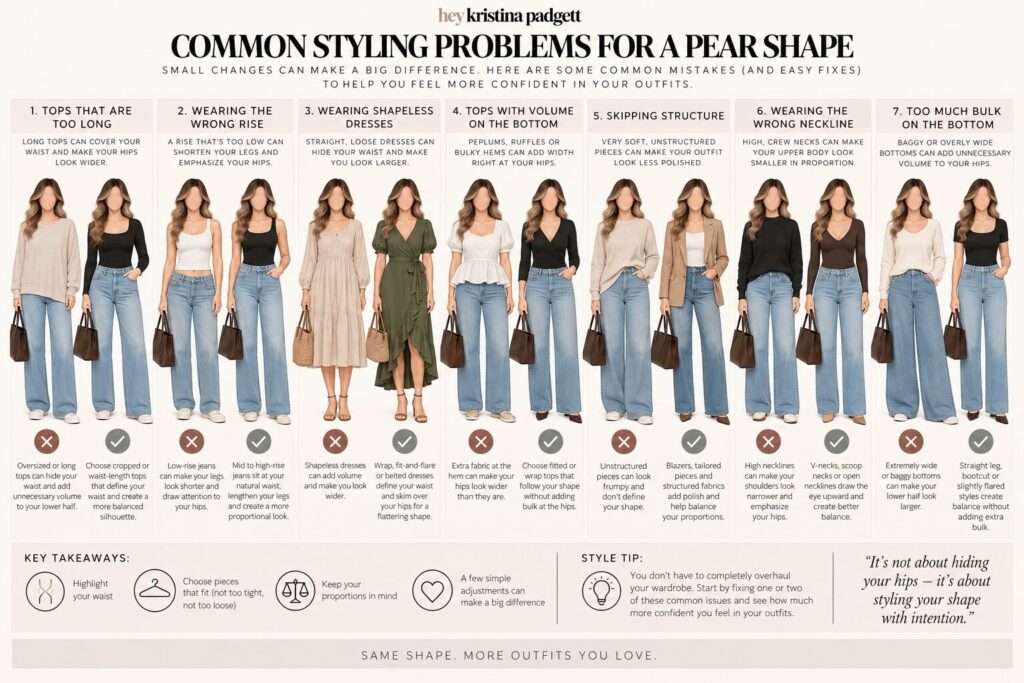
Common Pear Body Shape Styling Problems
Sometimes an outfit doesn’t look the way you imagined it would.
Before deciding something “isn’t flattering,” figure out why it feels off.
1. Pants Fit Your Waist but Pull Through Your Hips
Try instead: Fit your hips and thighs first, then look for a curvy waistband or have the waist tailored.
2. Pants Fit Your Hips but Gap at the Waist
Try instead: Curvy-fit denim, contoured waistbands or tailoring.
3. Your Top Ends at the Fullest Part of Your Hip
That horizontal line may be creating more emphasis there than you intended.
Try instead: Move the hem slightly higher or lower and compare.
4. Oversized Top + Oversized Bottom Feels Overwhelming
Your natural proportions may simply be disappearing underneath the fabric.
Try instead: Reveal a little waist, shorten the top or introduce one more fitted element.
5. Your Jacket Feels “Off”
Check the hem before blaming the jacket entirely.
Try instead: Compare cropped, hip-length and longline styles.
6. All the Visual Interest Is Happening on the Bottom
If you want the outfit to feel more visually balanced, introduce something up top.
Try instead: An interesting neckline, structured shoulder, collar, sleeve detail, jacket, jewelry or texture.
Small changes can make a surprisingly big difference.
Petite + Pear Body Shape
If you’re 5’4″ and under and have pear proportions, you’re working with two things:
Your body shape and your scale.
You still have the same pear characteristics:
Hips that are visually wider than your shoulders.
A comparatively narrower upper body.
Often a defined waist.
More visual curve through your lower half.
But now inseam, garment length and scale become even more important.
Pay Attention to Your Inseam
Petite jeans aren’t just shorter regular jeans.
The knee placement, rise and overall proportions can also be adjusted for a smaller frame.
Watch Your Rise
If you’re petite and short-waisted, an ultra-high rise may take up most of your torso.
A mid or standard high rise may give you the same waist definition without overwhelming your frame.
Cropped Can Be Your Friend
A “cropped” jacket or sweater may simply hit at the perfect waist length on a petite frame.
Watch Jacket Length
A blazer that’s supposed to hit below the hip may fall much farther down on a petite body.
Where the hem lands matters.
Hem Your Clothes
This sounds ridiculously simple, but it’s one of the biggest styling upgrades petites can make.
Pants pooling around your shoes can completely change the intended silhouette.
Don’t Be Afraid of Volume
Being petite doesn’t mean everything needs to be tiny and fitted.
You can wear:
Wide-leg jeans.
Full skirts.
Oversized sweaters.
Relaxed trousers.
Big jackets.
The key is understanding where the volume sits and how it relates to the rest of your outfit.
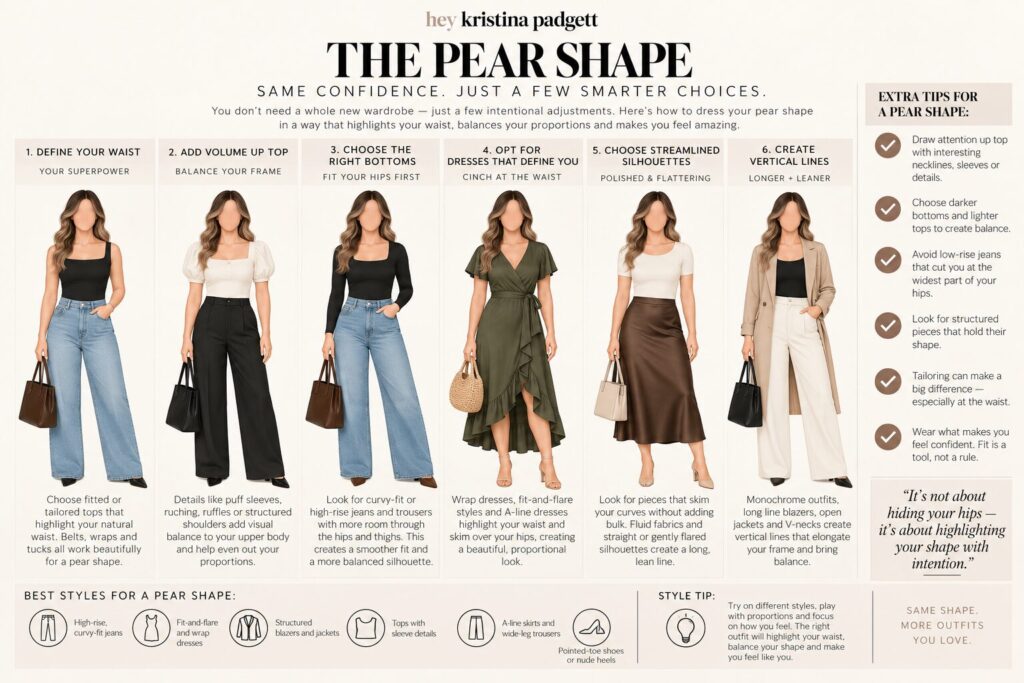
The Most Important Thing to Remember About Dressing a Pear Shape
Your pear shape isn’t something you’re trying to correct.
Your hips aren’t a styling problem.
And you don’t need to spend your life trying to visually shrink the lower half of your body.
Body-shape styling becomes much more useful when you stop asking:
“What am I allowed to wear?”
and start asking:
“What is this piece doing to my proportions?”
Where does the top end?
Where does the jacket end?
Where does the waistband sit?
Where is the outfit creating width?
Where is it creating length?
Where is it creating definition?
Where is the visual weight?
Once you start seeing clothing this way, you can manipulate an outfit without changing your body at all.
And that’s really the point of this entire series.
Same you. More outfits you love.